Blog Archives

Sacred Valley, Peru – Chapter 2
Machu Picchu day!!
This beautiful ancient city has been photographed thousands of times but I can’t resist taking a bunch of photos.
We meet our guide in line for the bus at 7am that will take us there in time for our 8AM arrival.
There is a crowd of people on that road as far as we can see….and it is the low season! She tells us in high season there are 5000 visitors a day there! We begin our visit and take many pictures from the various viewpoint.
We learn so much about the Inca and why they built the ancient city there. We admire the platform for agriculture as well as their experimental platforms. They had so many variety of corn and potatoes!


A view of the valley. I find the fact that they cared about the number of degree of inclinaison of each wall depending on the sun position and the status of the inhabitants, that they had an area for a school, that they had a water canal system and more is so amazing!
Good on them for abandoning it when the Spanish invaded to ensure that they wouldn’t find it. Again that story is impressive as well as how the story of it was mantained by the local tribes.
What a treat! We feel very privilege to have had the opportunity to visit it at low season on a bright sunny day.
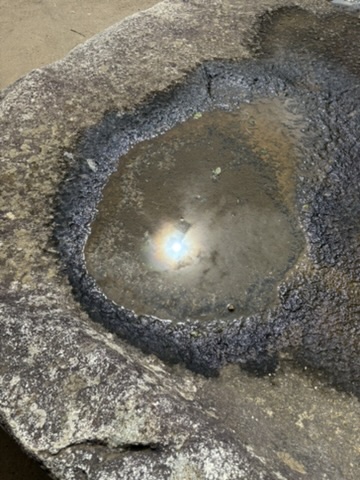
We are also very lucky to be by the reflection pool when the sun was reflecting exactly in it.
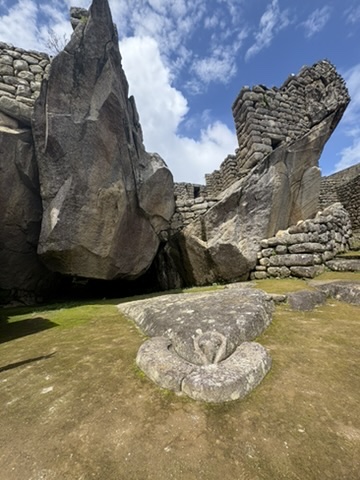
My favorite temple is the Condor Temple where they used rocks that were already there representing the wings and the body and simply added the head.
Humantay Lake: We have to rise at 4:15 AM to be able to meet our hotel pick up at 4:50  We then drive for 2 hours in a minibus type vehicle to the first stop – Mollepata – where we have our breakfast. We then drive an hour on a road that looks so dangerous so many times! Little mounds of dirt to act as guardrail, erosion can be seen here and there and OMG, the cars are actually going to face
Chuck can not look. The valley below is so far but the views are of course stunning. I manage to take a few pictures from the rocky, moving car.
Once we arrive at base camp, we prepare our duffel bags, use the washroom (unsurprisingly again with the squatting) and start our ascend with our guide Owen. We will move one step at a time from 3500 metre above sea level to 4200 sea level.
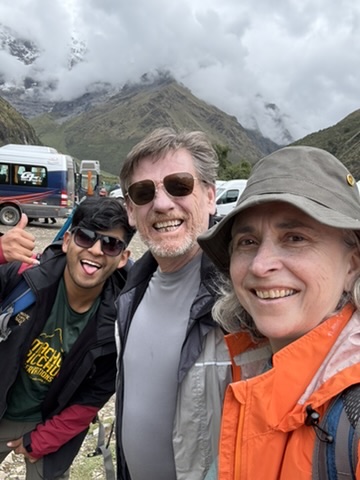
Many horses are available for rental from the local families. Owen informs us that there are 10 Inca descendants families living inside servicing this campsite.
There is a small house at midpoint but we can not see it at the bottom. We hike for a short while on relatively flat surface but quite quickly, we start feeling the incline and the altitude makes for laboured breathing. Owen offers us “coca” leaves to roll and put inside our cheek and some rolled up with another black substance (video). We also use the water of Florida which is alcohol with many local herbs that marinate in it. This is something you put a teaspoon in your hand and clap your hands and then smell heavily to open your lungs. You repeat 3 times. We are game and hope it will help.
I find it hard to breathe. I am offered a horse several times by Owen but I really want to attempt this hike myself. I begin a count of 100 steps before stopping and I try to stick to it. Stopping long enough to catch my breath. We make it to midpoint in an hour which is what they look for so I’m pretty happy.
We begin the second half with a short section that is a bit less steep and then move up the side if a hill that we have to go around to get to Humantay Lake.
I continue with the same pattern and Owen and Chuck stop with me and are very encouraging. Chuck struggles through his ki foot pain and is proud of making it as well.
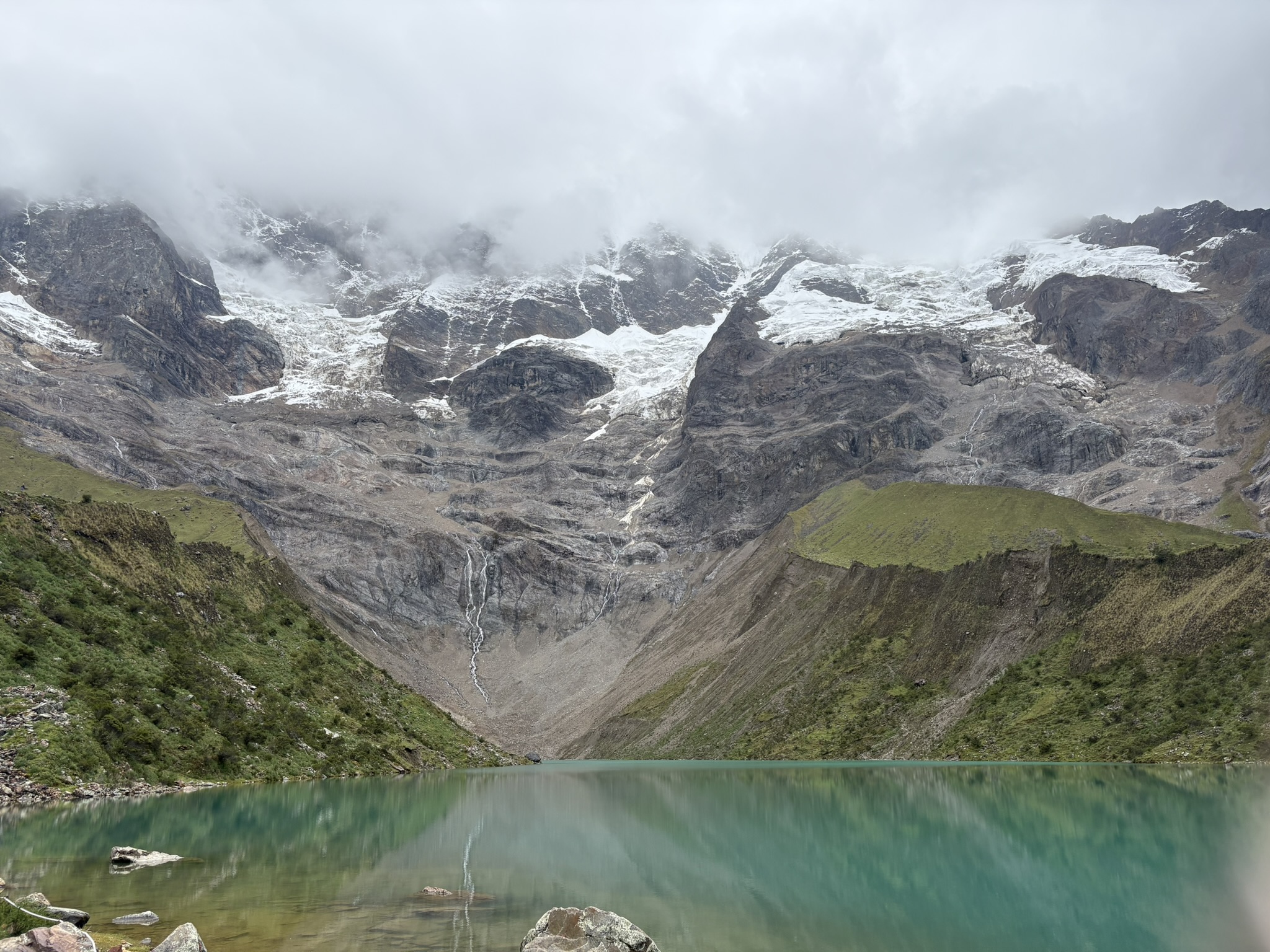
Once we turn the corner and arrive at the lake, it is quite the view.

It reminds us of Lake Louise but feels like the huge Humantay mountain behind which reach more than 6000 metres above sea level is bigger and more majestic as a backdrop for the lake. We take many pictures and hike to a rock for a better view. My legs are very sore and I am glad to sit. Chuck’s foot problem is starting to act up. While my knees are holding up, I can certainly feel them.
We start the descent which is of course much easier but harder on the knees.
It takes us an hour to go back down but it is now raining and it is getting slippery and cold. Once we arrive back on the outside of the camp, we make a left turn to go back up an “Inca ramp incline” back to the overnight camp. This feels harder and we are really done.
We make our way up to the dining house which is perched at the top because of the amazing view of Salkantay mountain and Salkantay pass.
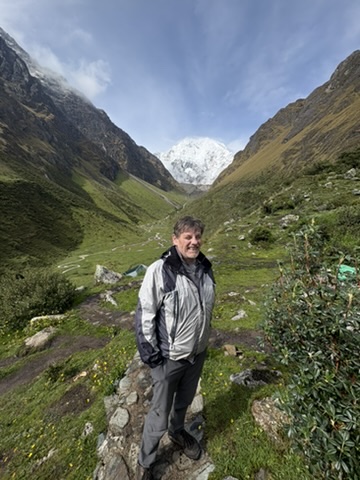
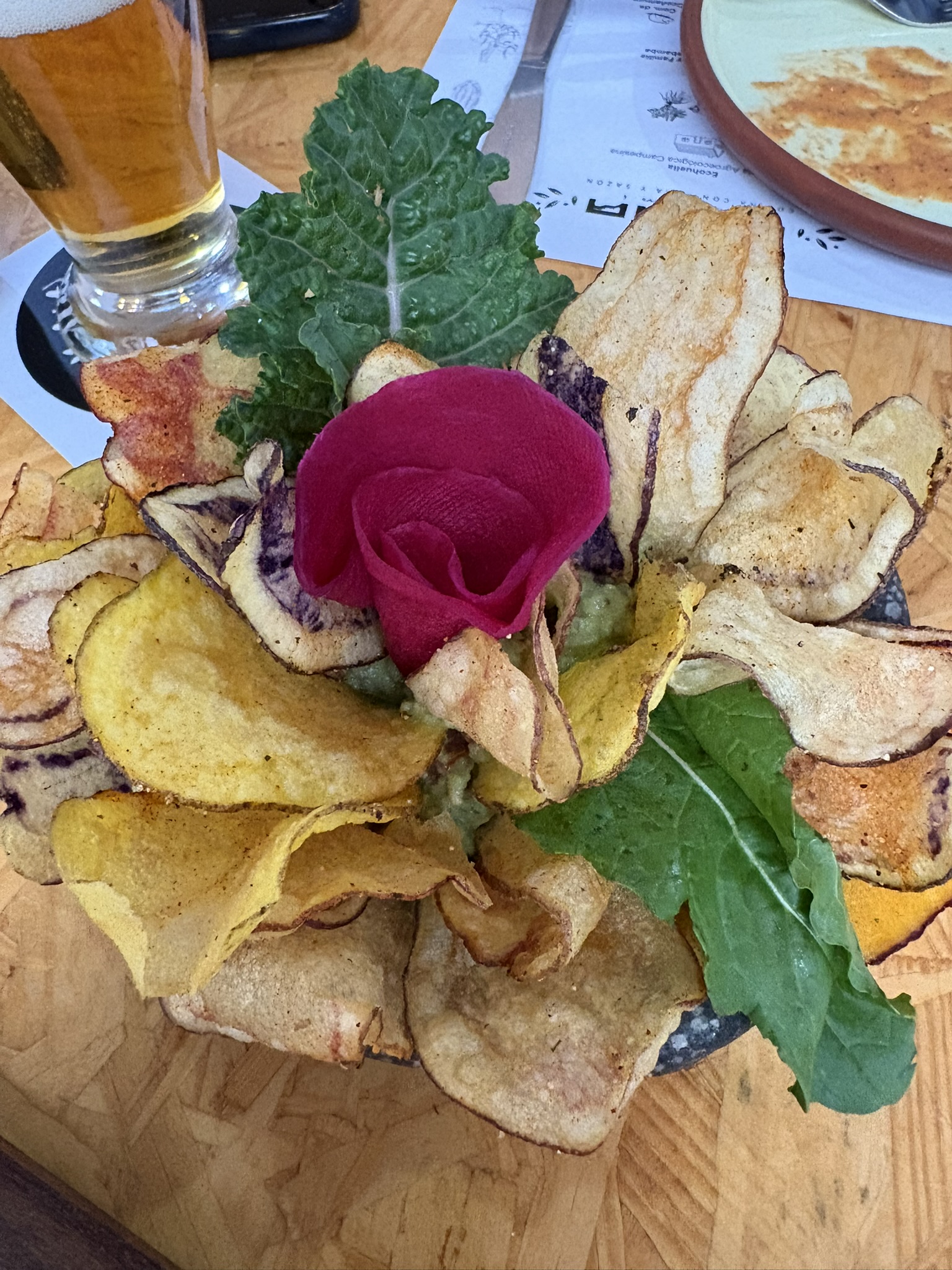
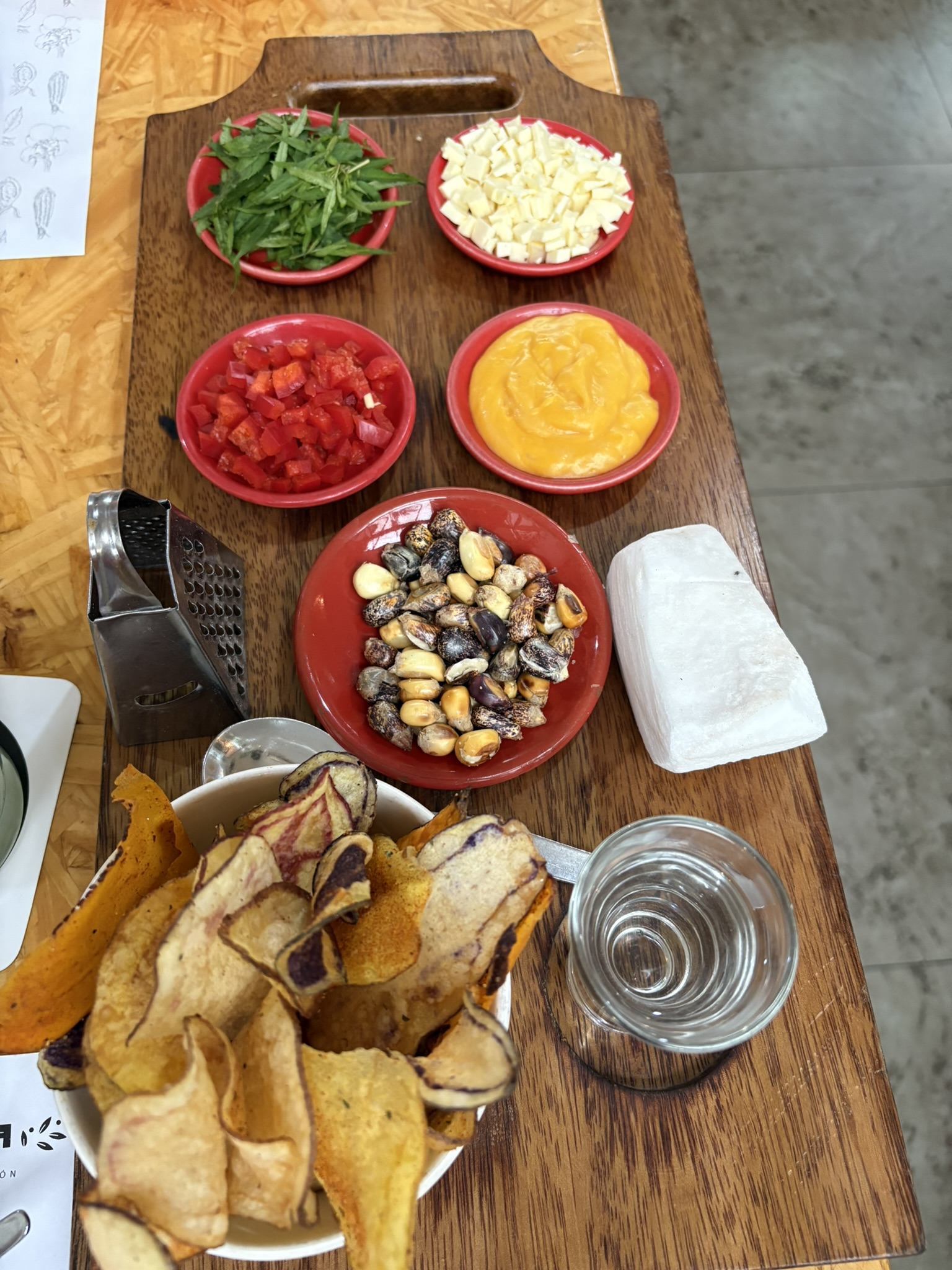
The next day we make our way back to Cusco early. Our marvellous travel agent, Ygor makes a reservation for us for lunch at a restaurant called Nuna Raymi. A wonderful farm to table restaurant whose mission is to support local indigenous organic farmers and offer real authentic Inca traditional food. The food was fabulous and the staff great – a must do in Cusco.
We walk to Plaza San Blas in the rain but walk up the steps anyways to take in the view of all of Cusco. I can only imagine what it would be on a clear day.
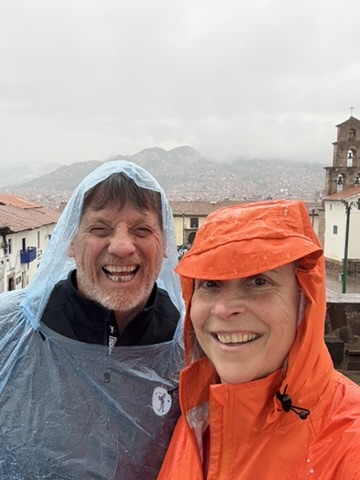
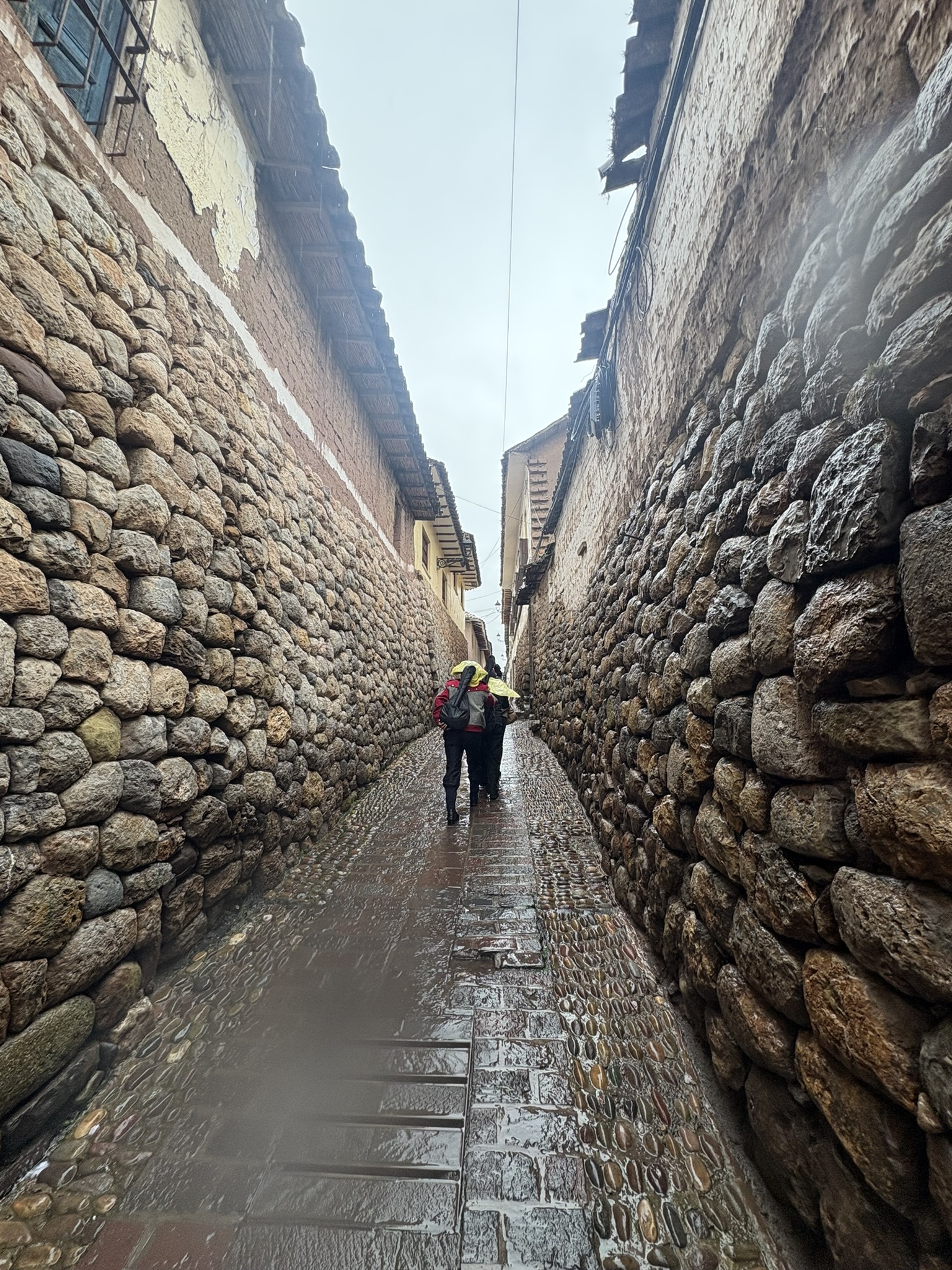
 Final thoughts as we leave for the Galapagos island today
 I was surprised by how few people speak English in such a tourist area. Owen explained us that for Inca- descendant, their first language is Quechua and then they learn Spanish. Both languages are very different so learning yet another completely different language like English is difficult.
I am very intrigued with the apparent absence of discrimination between Inca descendant and Spanish or other descendants. They seem to be completely integrated. Something I want to understand better.
While they grow coca leaves in large quantity, farmers are only allowed to sell leaves and this is quite rightly policed by the government. Consequently, they apparently do not have a drug problem (cartels etc)
We stayed at boutique hotels and were pleasantly surprised. For example in Ollantaytambo, our hotel is a family business and our host, Alex, is the only one who speaks a bit of English so he is our contact. We enjoyed there an excellent rich coffee made from local beans, very smooth and no bitterness.
All our guides were Inca-descendants at least in part and were clearly very proud of their heritage. They are passionate about sharing their heritage, languages, food etc…and refer to the Spanish invasion as the colonization time.
While we only visited the sacred valley, there is so much more to this country – coastal region, desert, jungle and highland (mountains). Consequently their agriculture is very varied and we feel we have only scratched the surface.
We loved it! 

Trip to Sacred Valley, Peru – 1st chapter
January 5th 2024
Our trip to Sacred Valley in Peru – 1st chapter
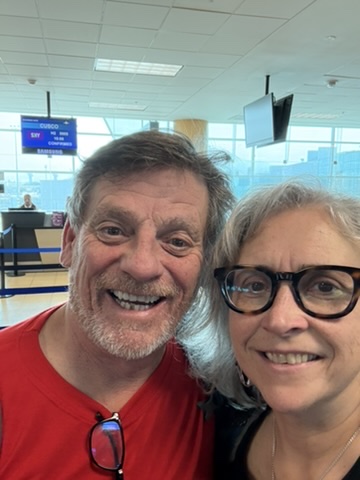
1- Chuck and I boarding in Lima
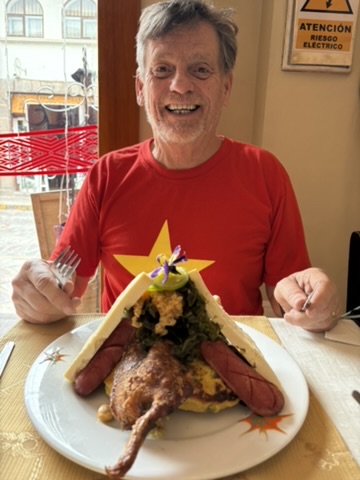
2- Chuck having his first typical local meal – basically all kinds of meat with a fat corn pancake and the best Andean cheese ever!
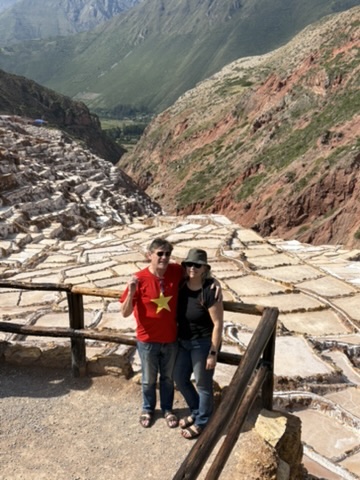
3 + 4 – the Maras salt mine – such an interesting place. These platform “mines” are very interesting in their ownership structure as well as the method to extract salt and the source of the salt water.
The salt water comes from pockets in the earth. Their origins is a source of many legends but we are far from the sea so it is very odd.
To extract the salt, they flood the platform twice a year for 3 months beginning in April. Each platform receives 30cm of water and the sun enables the evaporation. From time to time the family will move a salt layer that accumulates at the top to enable the rest to be evaporated. The end result is 3 layers of salt, the top white one is the best for domestic consumption (the flower of salt), the next layer is pink and is for domestic consumption as well. The next level is black-ish and is sold to companies and used for commercial purposes, one of which is ….. processed food  .
.
The platforms are all owned by local families going back hundreds of years. Each family may own 5 to 30 platforms. They formed a cooperative that manages the process and takes care of sales. The families can only sell their platform to another family that lives within the surrounding area. They are now expanding the platform to the end of the valley and now those who live in those areas will own the new platform. The government protects this ownership structure and no large company can ever own the platforms.
5- we arrive in Ollantaytambo for a catholic celebration with parades, music and dances. This is a very safe city mostly populated by Inca descendants. Very fun party that will last 4 days.
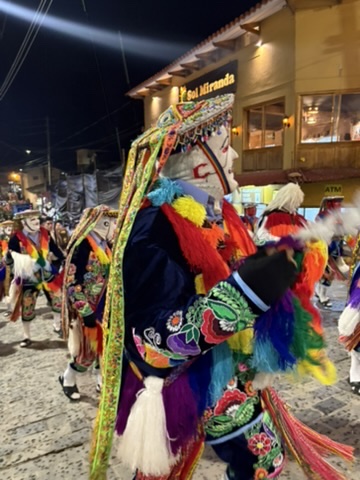
6 – In that city, there are Incas and pre-Incas ruins. There is an intact pre-inca temple dedicated to water where a canal bring water from the nearby Andes mountain with a window above facing the sun.
We discuss these ancient civilizations include the very first one more than 5000 before JC named Caral (north of Lima) and we still see their signs “Chacana” carved in one of the stone, adopted by the Inca. Jose explain that the Incas method to conquer was to assimilate the other civilizations by their princes or kings marrying the princess from the conquered. These tribes also all believe in a creator of the world as well as many gods related to nature like the sun, the air, the water. The Incas incorporated the names used to refer to the creator in how they named him in their religious ceremony. So the name they used became a combination of all those names. They also always offer to exchange their knowledge for the knowledge of the conquered so that they could build on that.
While they also had big battles as there was in Europe, the difference is that they were not trying to annihilate the culture of those defeated but rather incorporate/assumilate it to build on it.
Peru also handles their native people – descendants of the Incas – much differently than Canada. They live side by side with the Europeans descendants called Metzi, while also there are mostly Inca town (like Ollantaytambo) who live and dress as Incas. This is welcomed and allowed. There are no “reserve” and no separate political structure/rulers. They are all governed by the local government who will be composed of all the communities. Discrimination does not seem prevalent here. Seems like a better way.

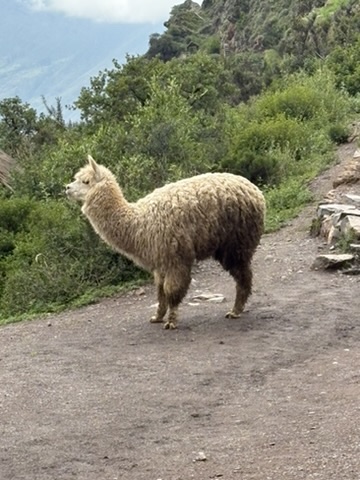
7- a beautiful alpaca in Pisac (not yet sheared)
8- high up in the mountains at 3500metres, the ruins of the village include pre-Inca (Wari) and Inca structure. It is again a hike up steep and higher than normal. We continue to look for our air but it is already better than yesterday. The view up there is spectacular! they believe that villages were built up high to avoid the massive flooding that would occur in the rain season in the valley.
The village up in the side of the mountain was abandoned in the time of colonization and a newer small village was built in the valley in the 15th century.
He also points out holes in the mountains which is a cemetery. Incas had buried their dead’s there in a fetal position – ready for the next life. Almost all have skull damage, indicating that there was a battle here to conquer the people. The holes are there because of grave robbers but there are many more dead’s buried there.
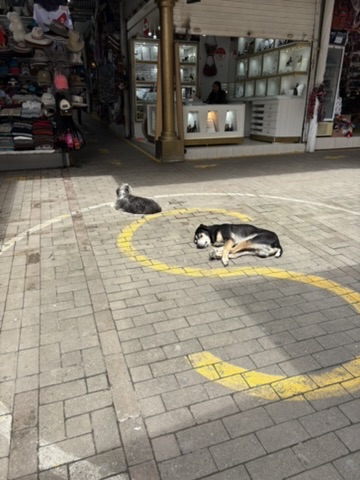
9- One observation as we leave the sacred valley. There are scores of dogs wandering around freely in all the rural area. More small dogs than big ones. They are obviously cared for and fed but loose. All are very calm, hang around together and I didn’t once see a reactive or aggressive dog. Very interesting.
 Martine's food and places