Category Archives: Sacred Valley + Galapagos island 2025

Galapagos – Isabella Island: the last chapter
Nellie, our new guide, awaits us at the dock in Isabella after a 2-hour speed boat transfer from Santa Cruz at 7am.
We then begin our tour to the breeding centre and the wetlands.
Even though we have been to several tortoise centre, we still continue to learn more.
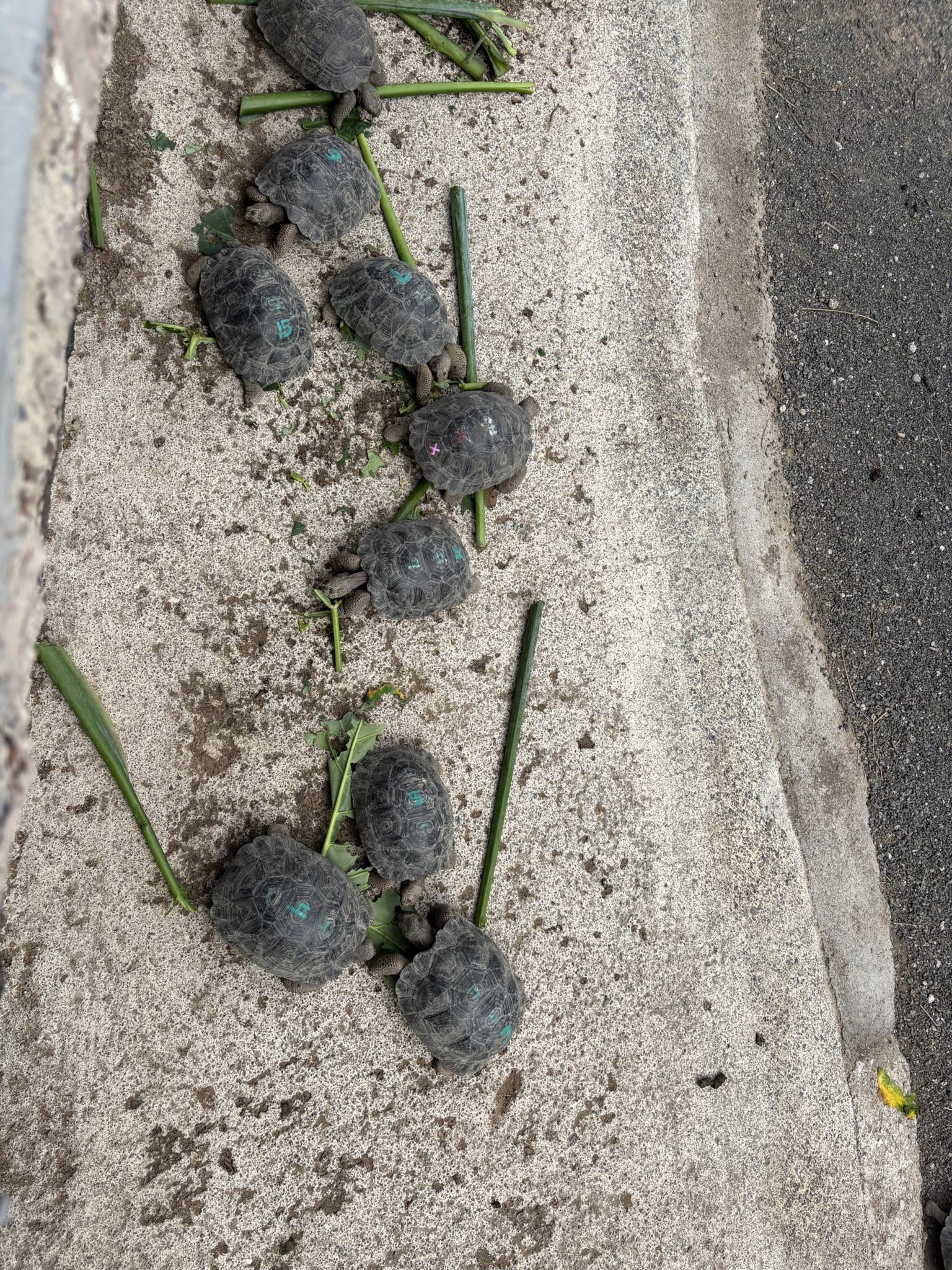
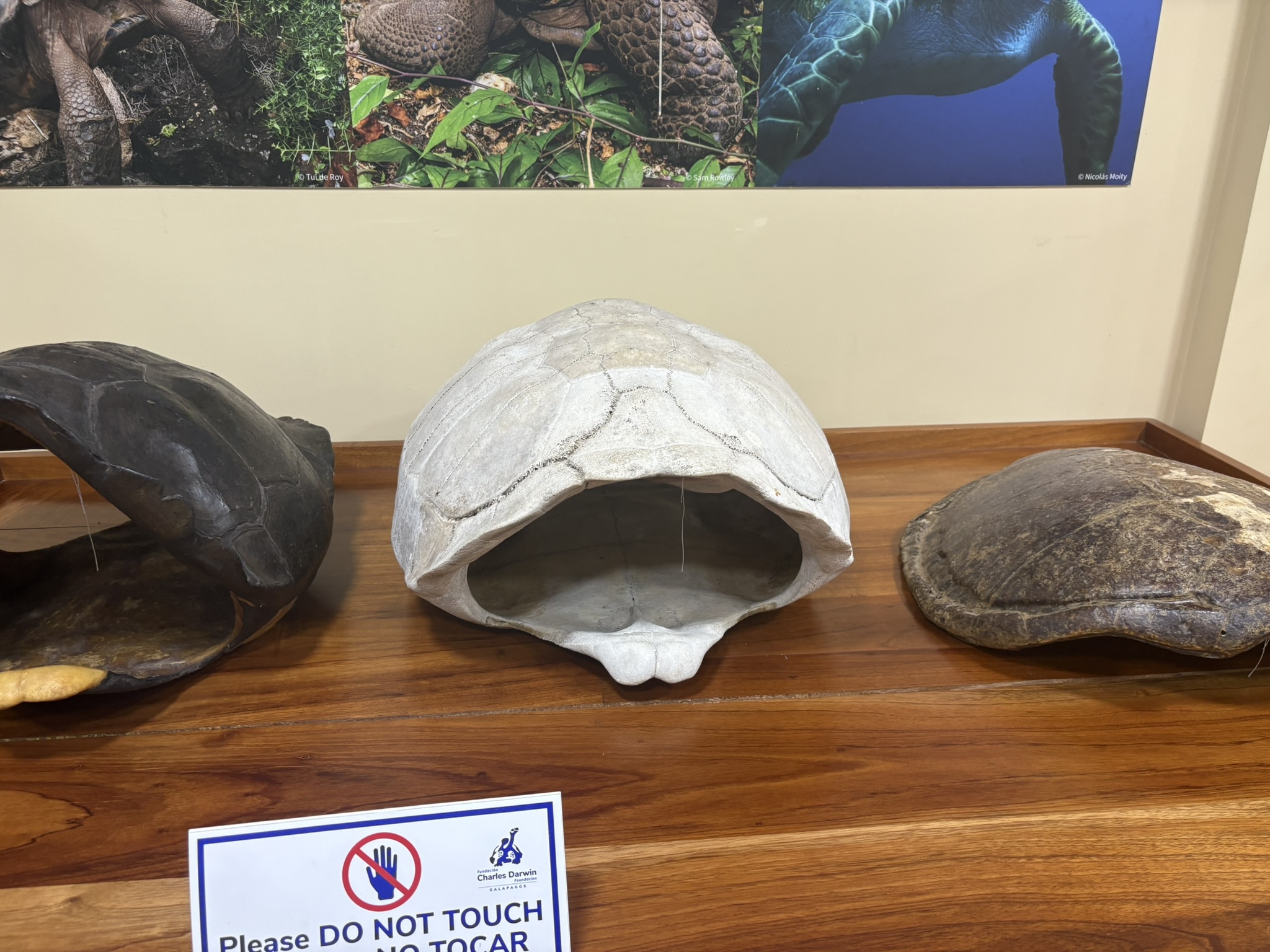
For example, tortoise are at their most sexually active after 100 years old. Here they are only looking after tortoise endemic to Isabella. They have been breeding for 85 years and are seeing success with many sub-species where young ones over 5 years old have been reintroduced. We observe the last 10 remaining survivor of a sub-species that had adapted to the dry area of the Cerro azul volcano. Where their shell reshaped from being a dome shell where the neck can not extend to the flat shell that allows the neck to extend up to feed on branches rather than from the ground.
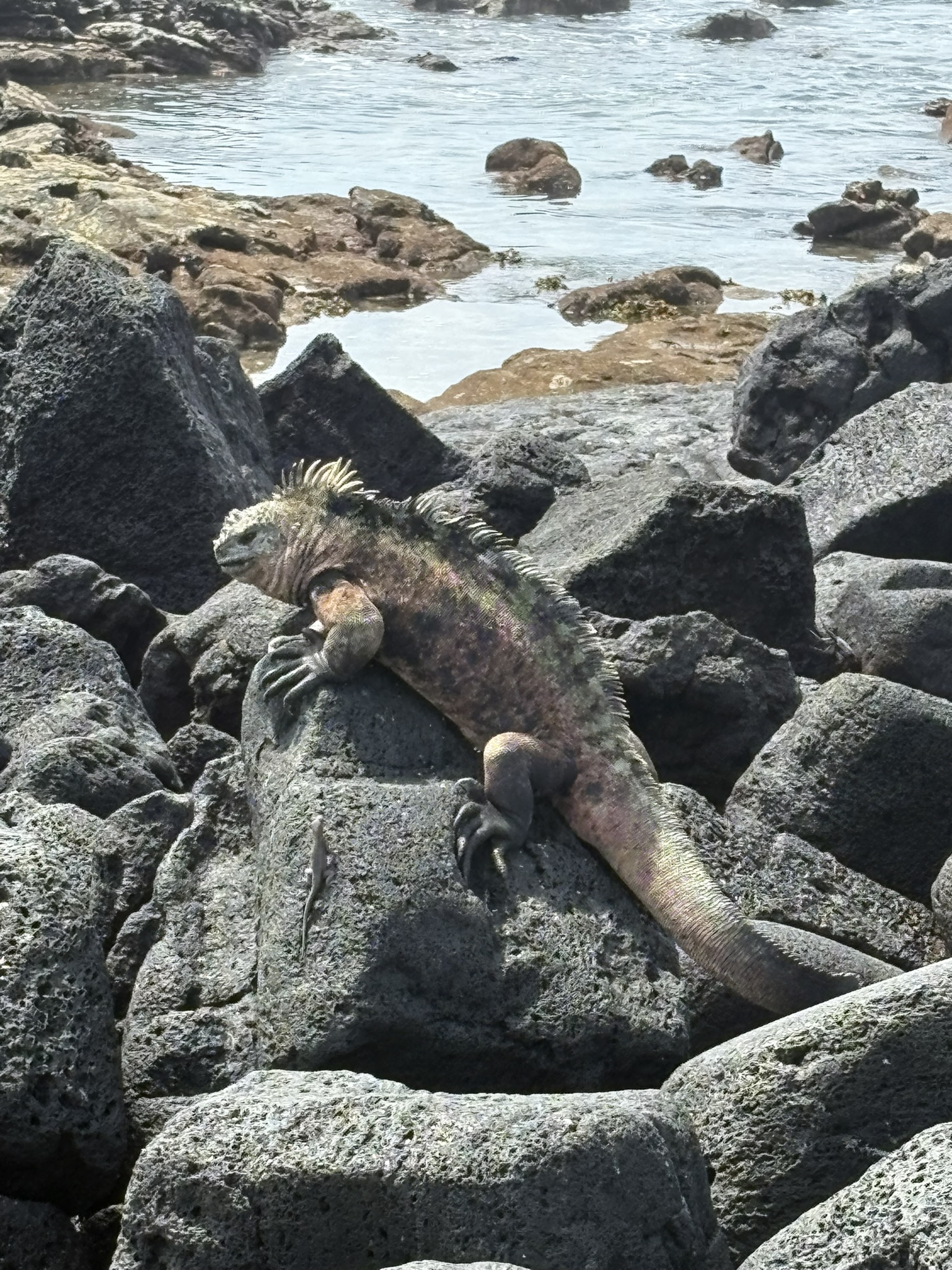
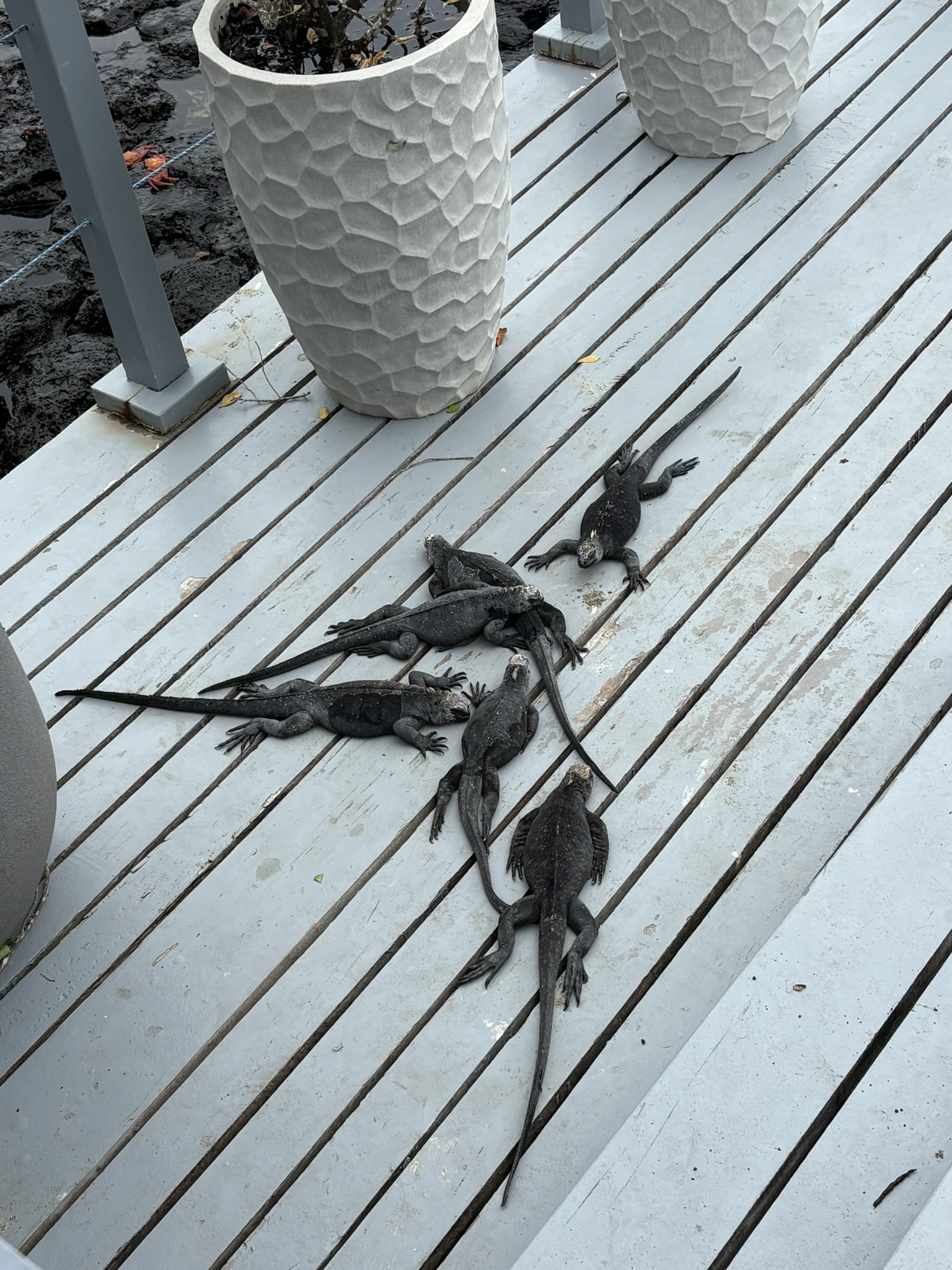
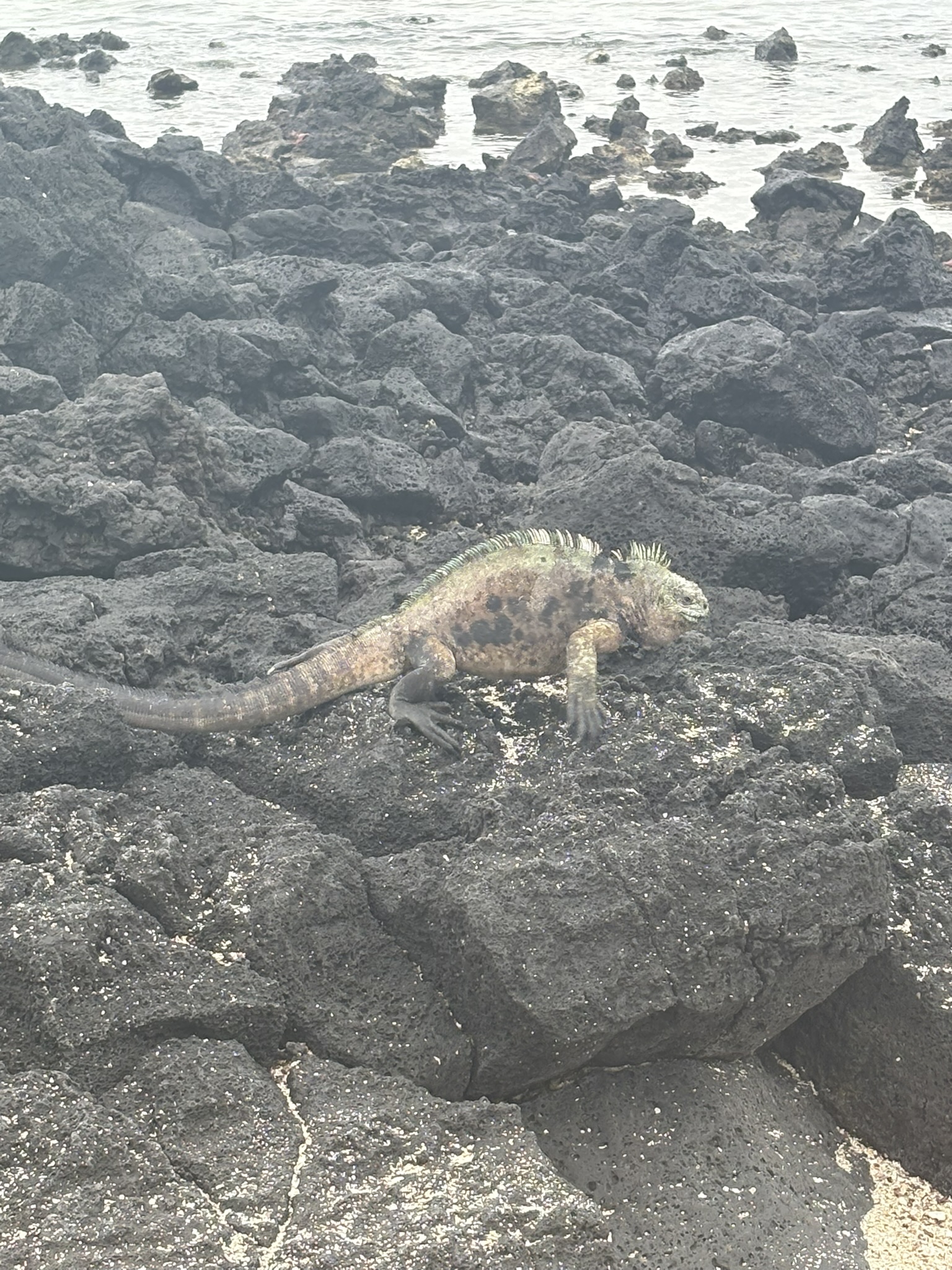
Over at the wetlands, we learn that marine iguana are like sea turtle in that they make a nest on the beach and lay their 2-4 eggs there. Once hatched the baby will race for the water.
The female mate and lay eggs only once a year but the male can mate again so we see many males showing off trying to attract the female with their bright color as they stake their spot on a rock. They have to wait for the female to come to them but once they are close, they will bite their necks and wrap their tail around them in what is referred to as a violent mating.
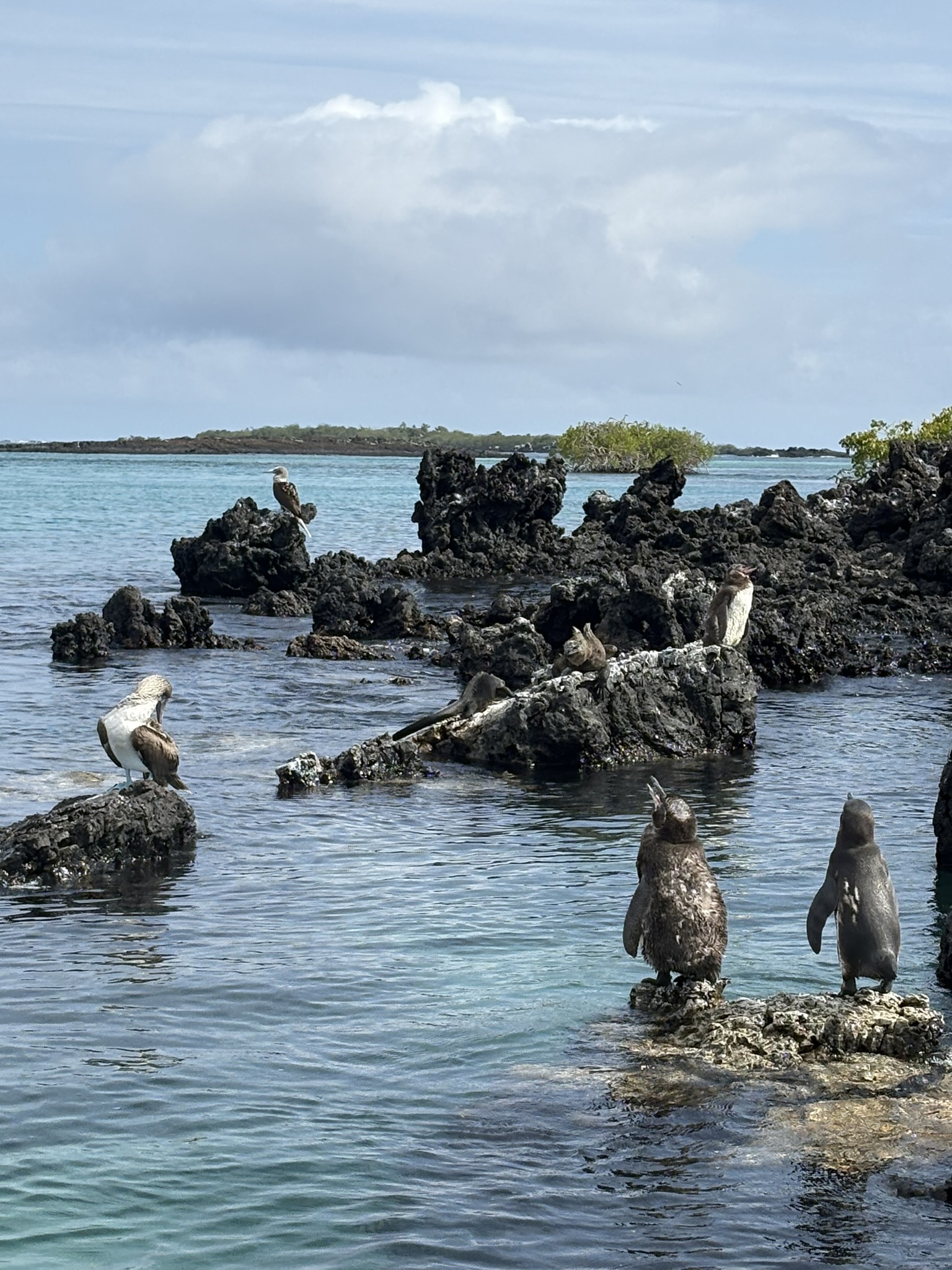
Along the way, we pass by rocks where multiple species are hanging out together – penguins, blue-footed boobies, pelicans and more.
A couple a bright yellow warbler.

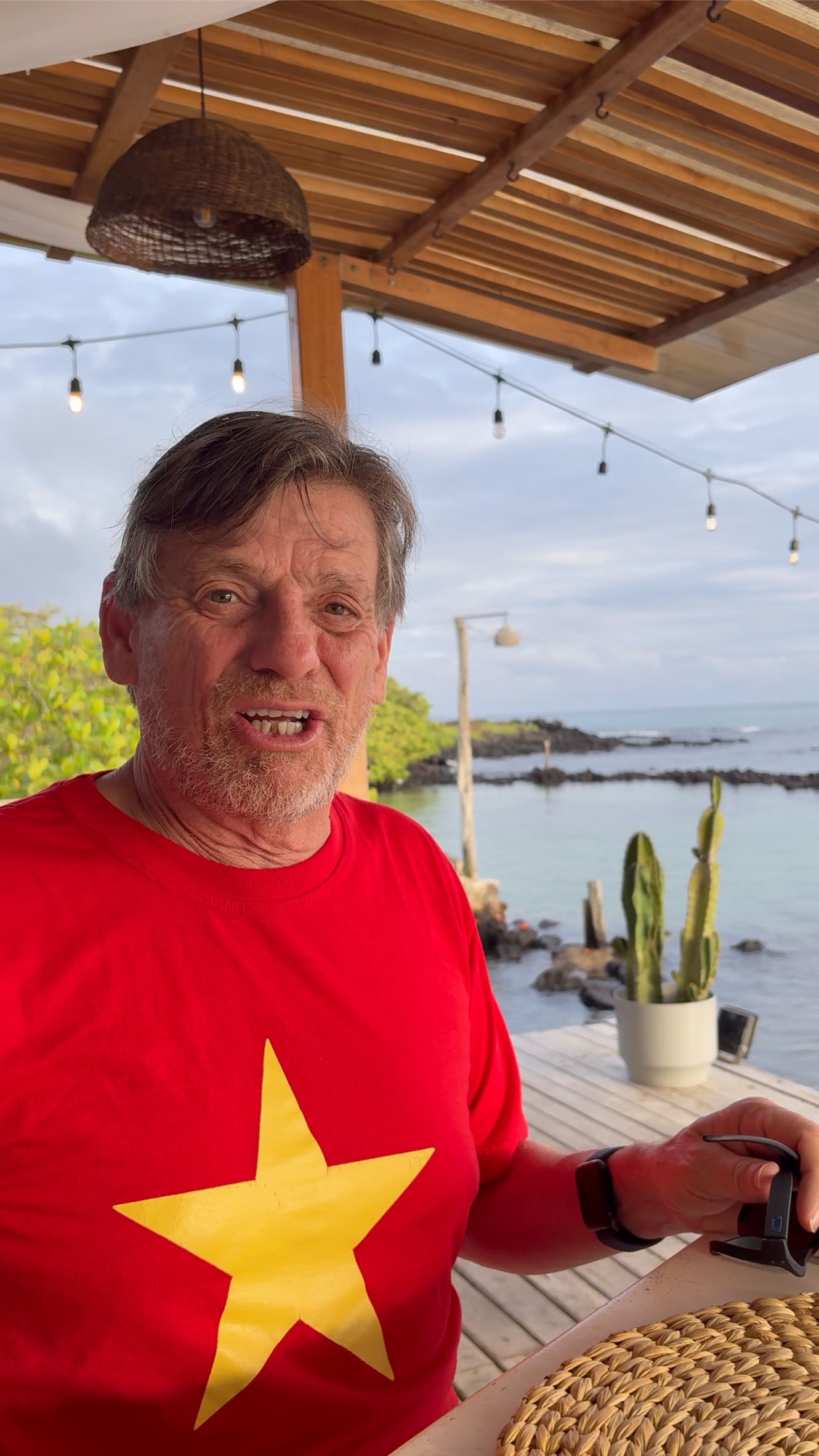
Our hotel is right on this beautiful beach! During our tour, we meet a couple from Belleville and the wife is a professor in the faculty of education at Queens. She came here with 4 of her post grads at the university of Ecuador. She tells me that they are so far ahead of the Canadian university in this field. All teacher candidates must learn sign language, do intensive training in special education (in Canada, they are lucky if they get 2-weeks to learn how to look after autumn, adhd etc…). They also learn a minimum of 3 languages as all the natives languages here are recognized and taught in local villages. We could have chatted for hours!

Today we had a lazy morning as our tour only started at 11. I finally realized that we can rent go pro so I make my way to the store to do that. I’m excited!! We then find a nice spot on the beach to have coffee and enjoy the beautiful beach and view.
I climb up the viewpoint and am startled with a large male iguana not happy to see me! The view is worth it though.
The first stop on our tour are what is simply referred to as the tunnels. It was hard to imagine what they meant when they referred to above ground tunnels but that is what they are. This is the most unusual landscape we have ever seen. Tunnels of lava as far as the eyes can see – very beautiful!
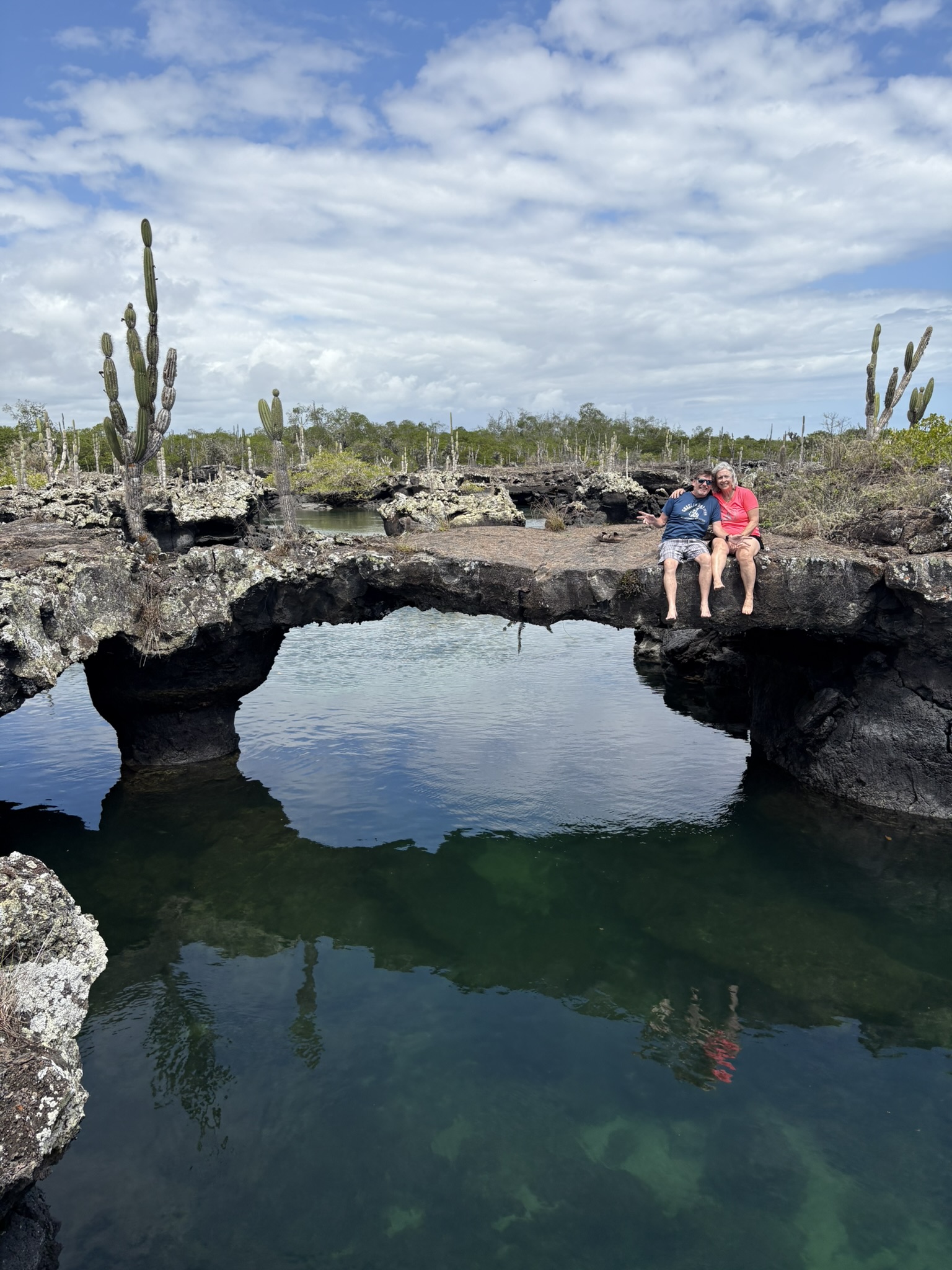
There are no iguana here as there is nowhere to lay their eggs but plenty of lobsters which is where most local fisherman come. There is hope that the area will be closed to fisheries in the next few years to maintain the ecosystem.
There is a blue footed booby nest with one chick of about 4 months old. They usually only have a maximum of 3 eggs and often time the first chick to hatch will throw the other eggs down the nest so only one survives. They can not fly until 6 months old so we are able to take a picture with it.
Our guide is Darwin and he is really great. He knows all the great spots for pictures !

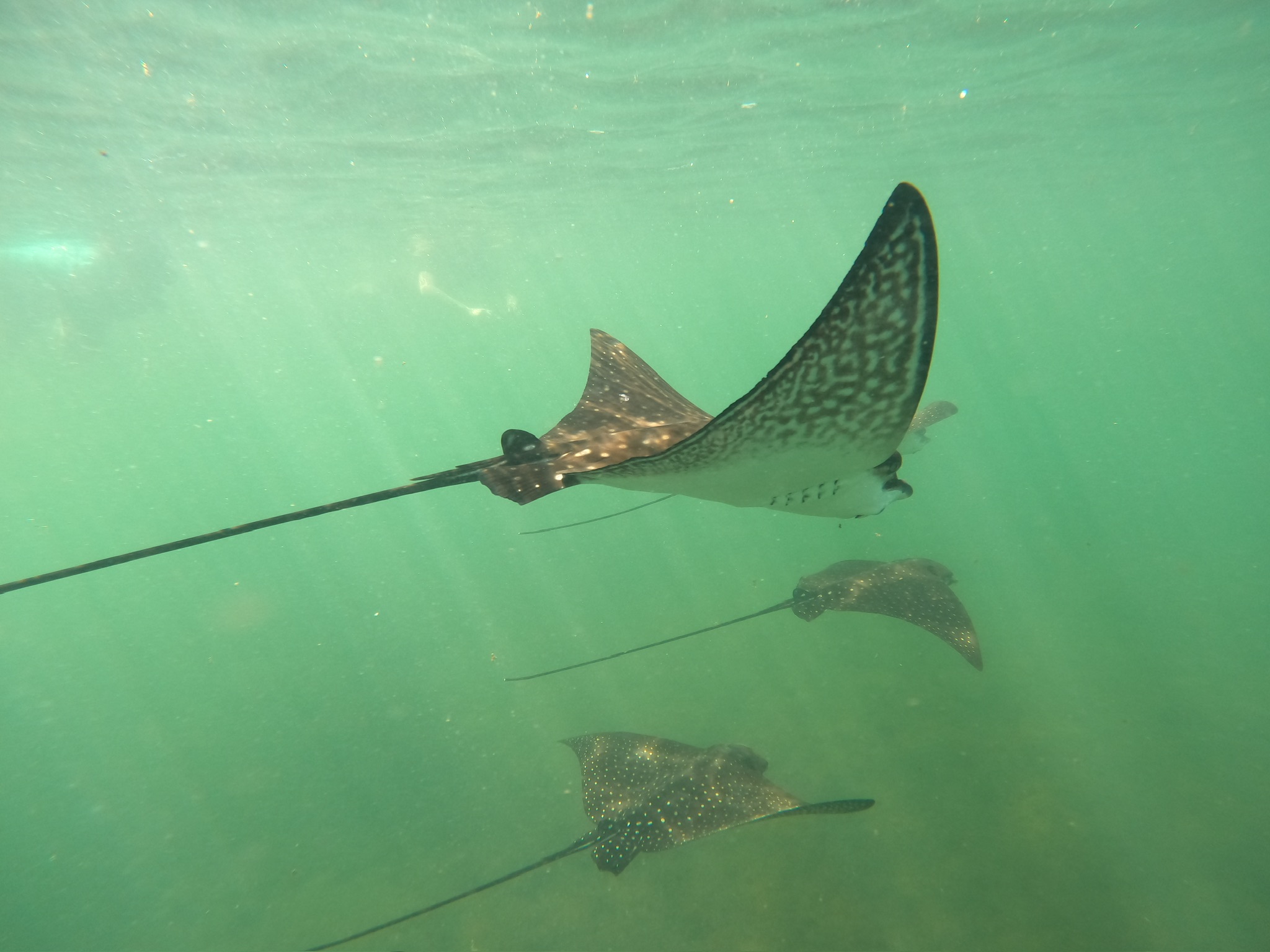
Afterwards, the boat takes us to another area along the cost of Isabella for snorkeling. There are giant manta ray swimming right by the boat!
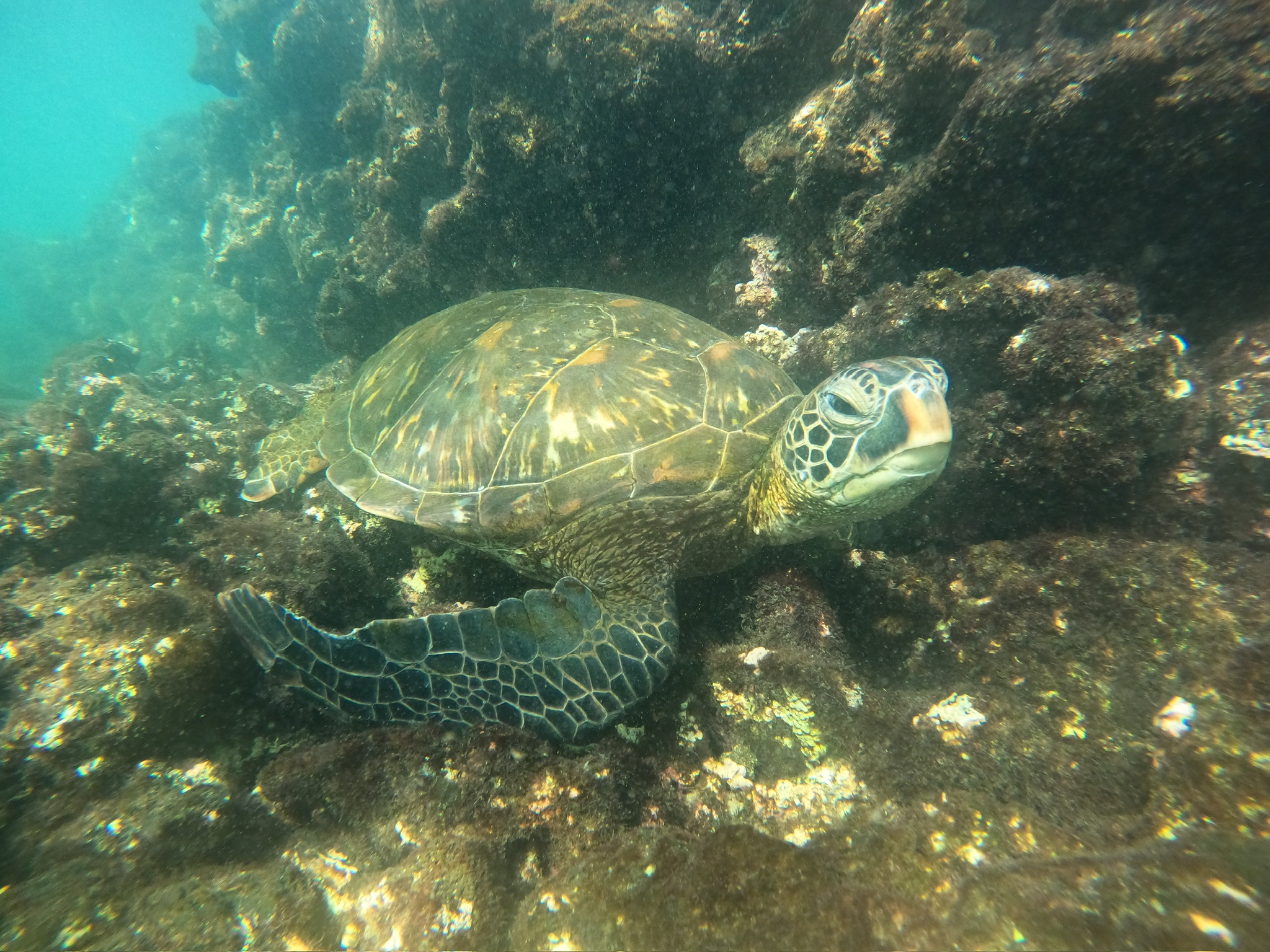
Darwin, our guide has an underwater camera as well and is determine that we are as many different types of sea animals as possible. We see sharks again, groups of stingrays, large turtles and then he takes us amongst the roots of the mangroves in search of the SEAHORSES. We finally find a few and it is truly magical to see these small animals hanging in the roots of the mangroves with their tails curled. When scared, they extend themselves and look just like a piece of stick! It is very cool!


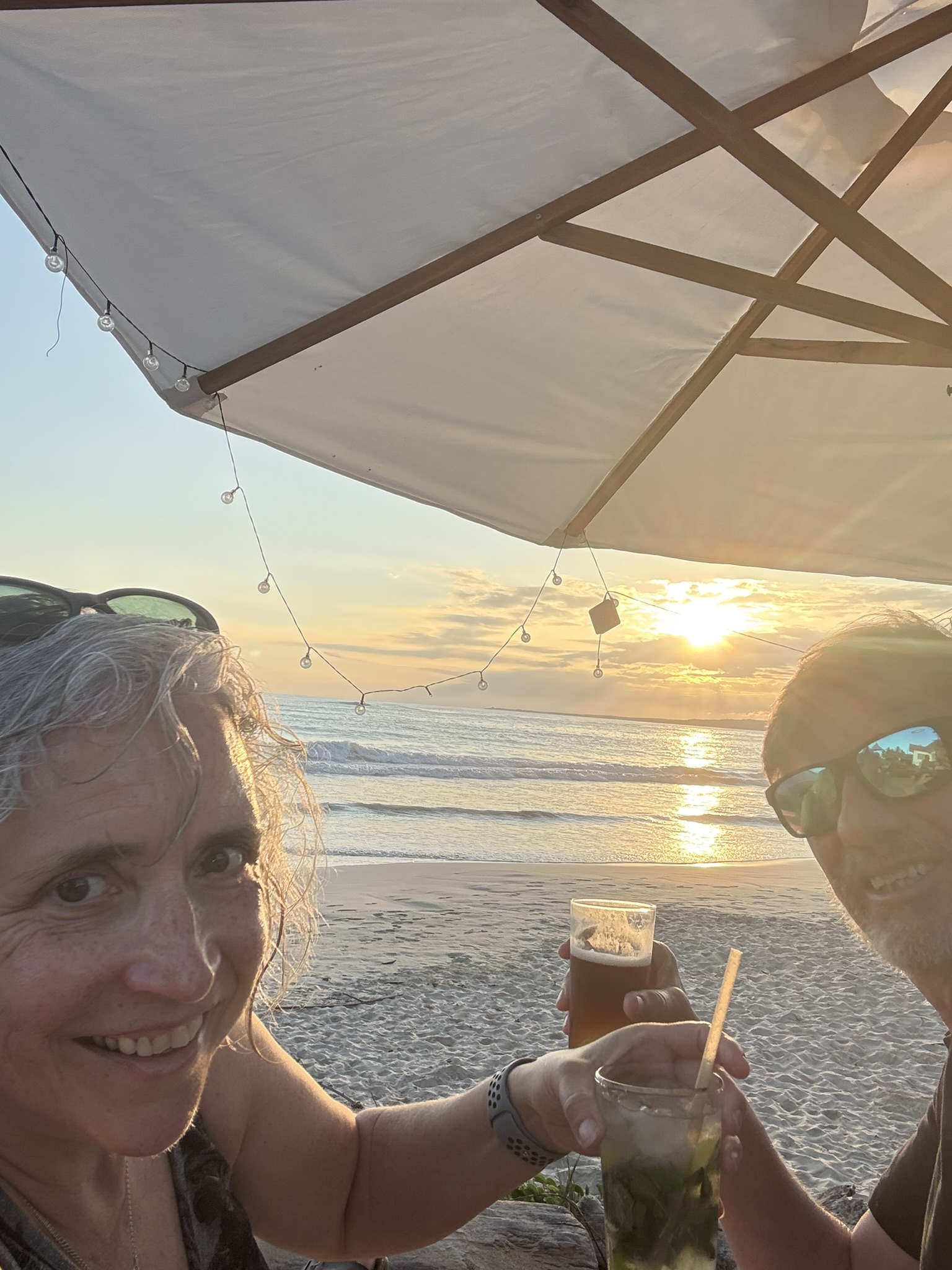
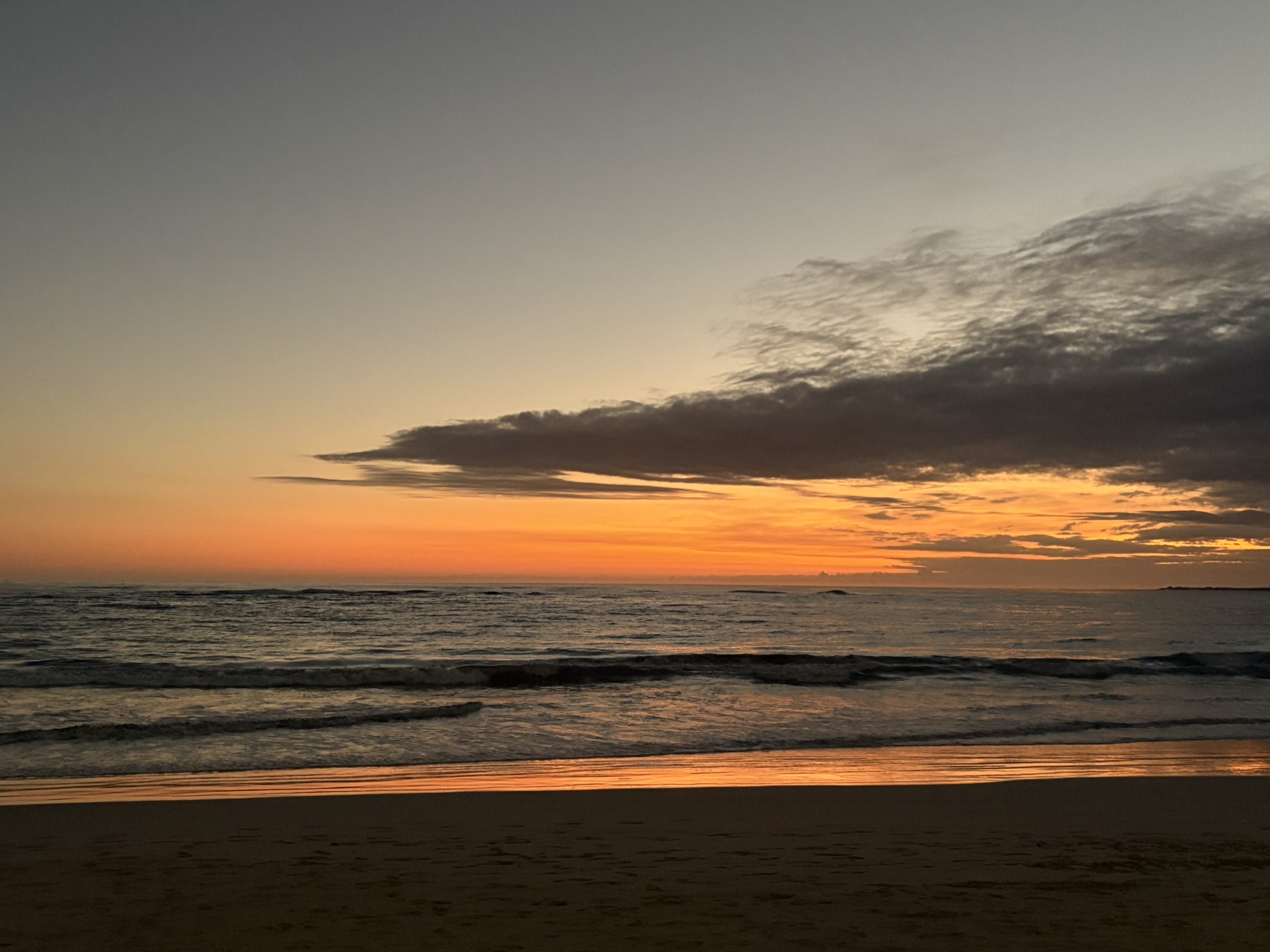
We have a lovely dinner by the beach watching the sunset and listening to the waves crashing.
Today is our last day – I’m rarely sad to leave after 2-weeks away but I would have been happy to stay longer.
We hike the Sierra Negro volcano with Nellie.
It is a gentle incline up to the top where we come to the second largest crater in the world (biggest is in Tanzania).
We see many Galapagos vermillion fly catcher – gloriously red which indicates a male. They are thought of as the lucky birds so we are lucky to see many.
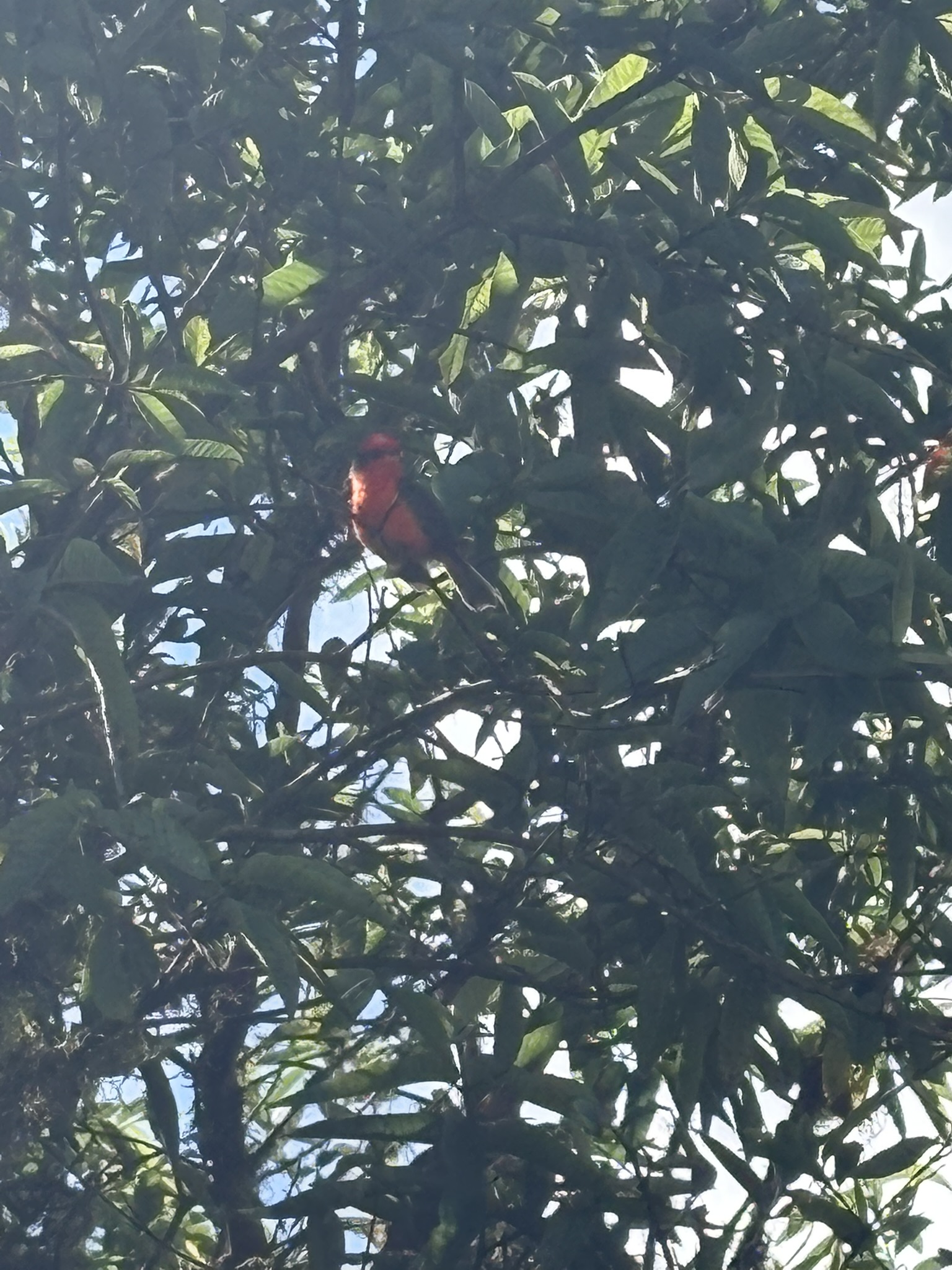
The check in point is at 800metres and the top at 1000metres above sea level. That’s nothing for us!
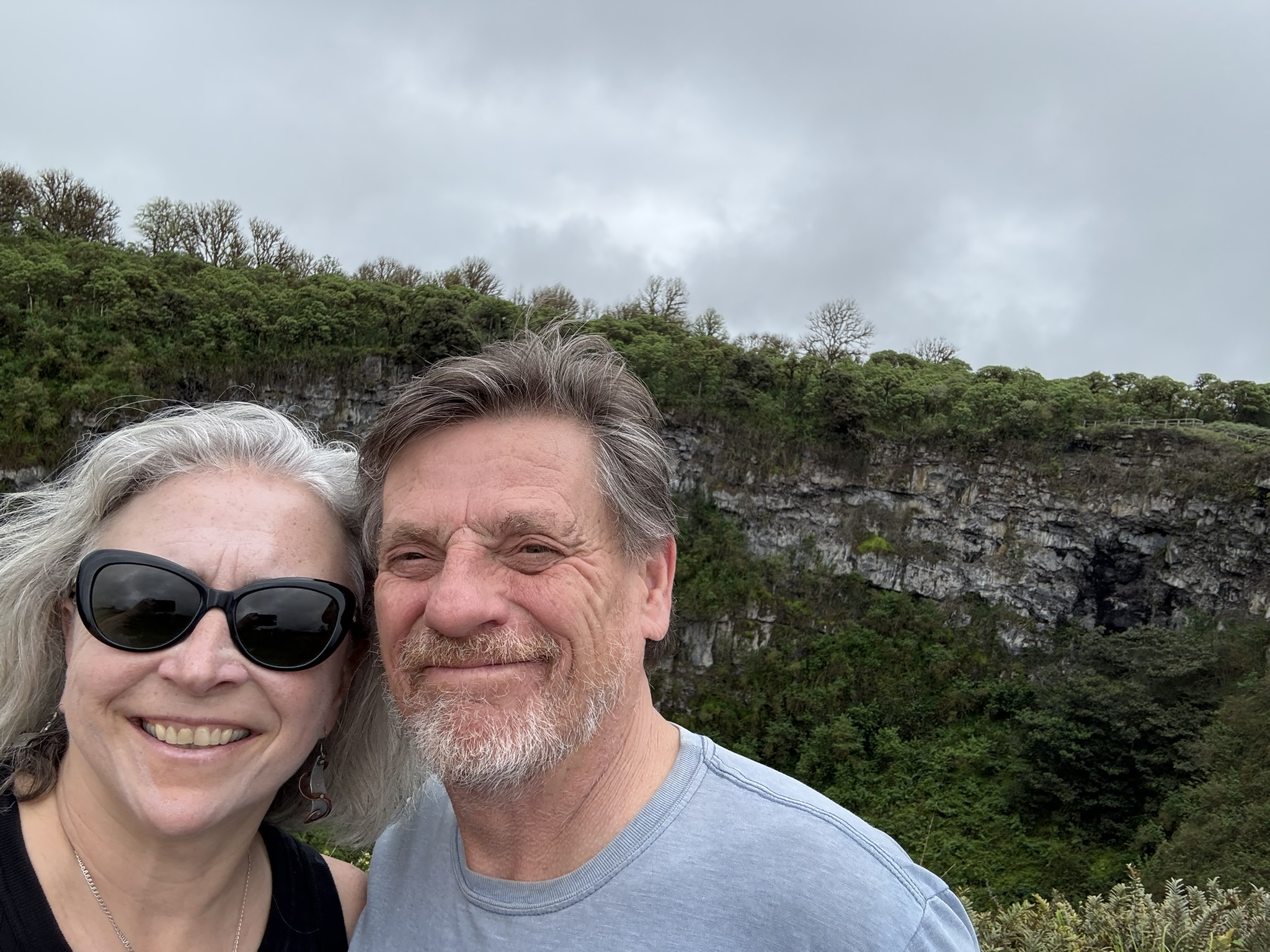
The crater is 9km long x 7 km wide. It is still active and the last eruption was in 2018. Many people came up to see as they are not volcanoes that erupt high in the air. The magmatic chamber is 3km deep and is connected to the hot spot. Isabella grew 1 km into the sea with the lava rock at that eruption.
We then drive to a nearby organic farm. The owner Marcelo greets us. His mother is now 100 years old and his father just passed away a few months shy of 105. He farms mainly produces and chicken. Everything is delicious and fresh. All the farmers in the Galapagos must be organic. No chemical allowed.
A few places, we visited were accessible via paths covered by beautiful native mangroves.
Another beautiful evening by the beach!
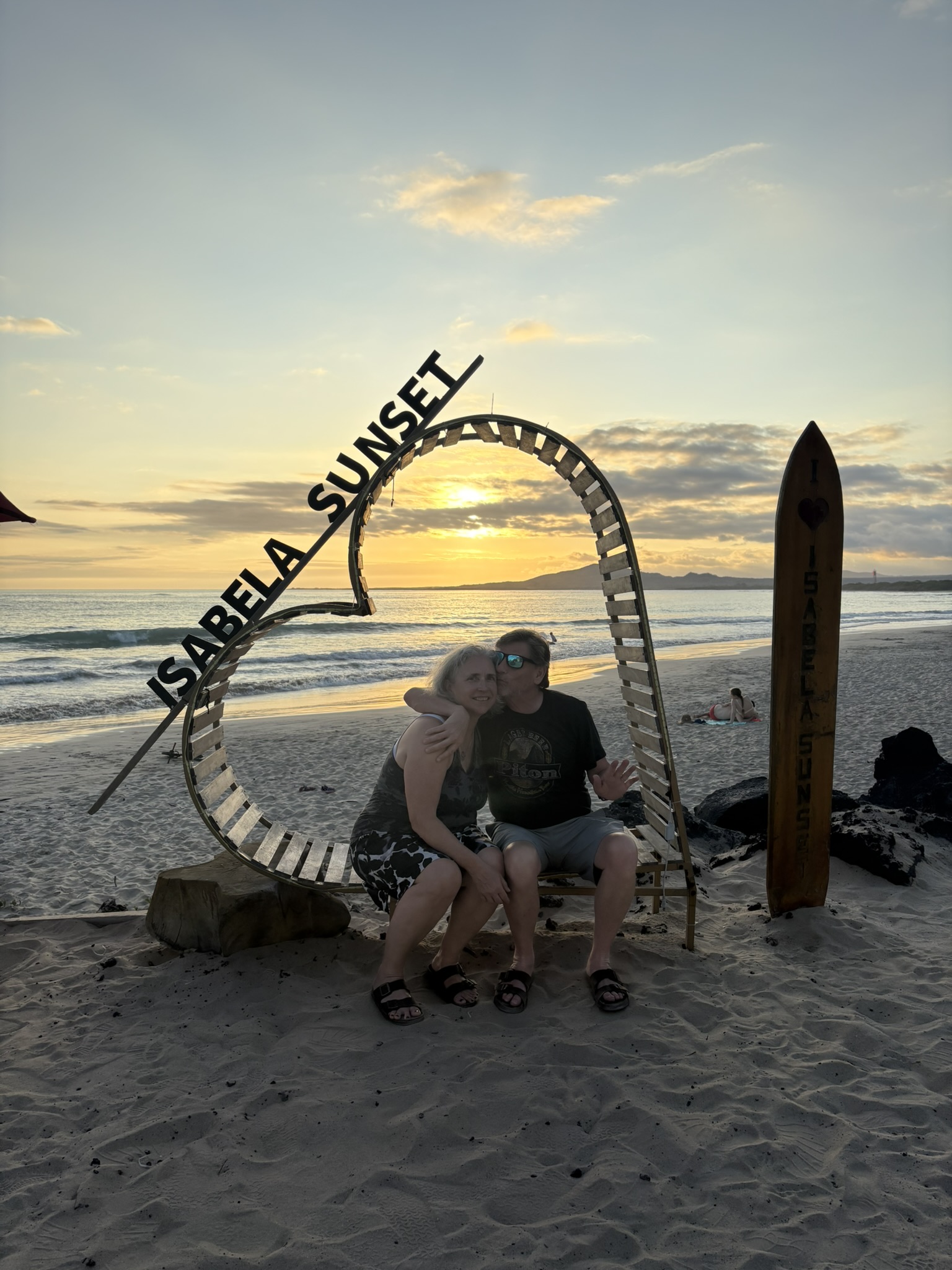
On our way back home after one of our best vacation…..truly loved this area and its people.
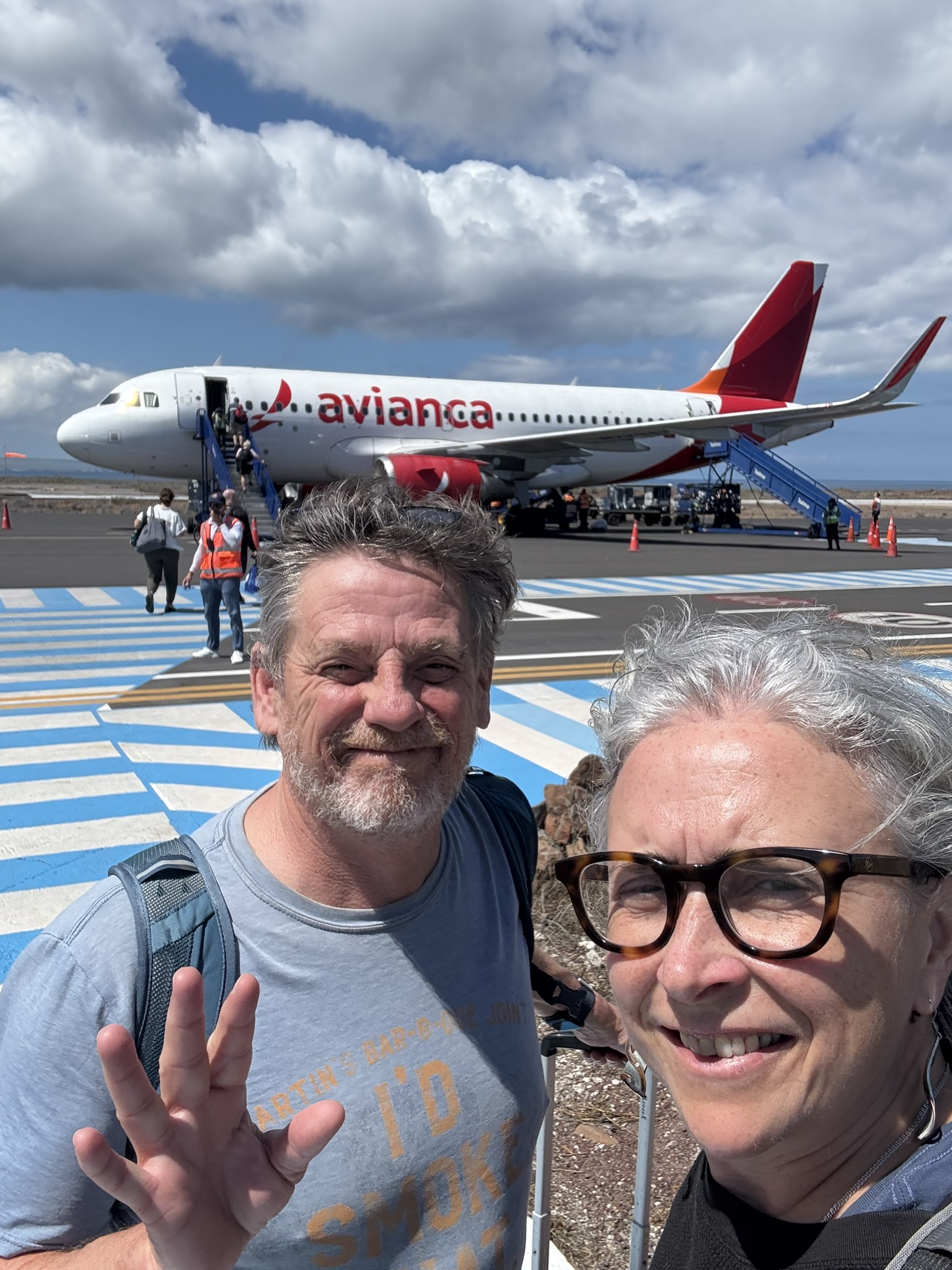
Facts
 We had a mixture of group tour when at sea and private tours when on land. I must say the private tours were well worth it as we are able to set the pace and customize what we want to see.
There is no homeless problem in Galapagos because immigration is only allowed when there are homes available. 97% is protected land so they restrict the number of inhabitants in the other 3%….maybe something to think about.
Water is a problem in Isabella . They have some brackish water for shower and toilet but drinking water is from purified rain water in the rainy season but in the dry season they must buy is from mainland. We forget how lucky we are in Canada. I wonder if we manage this precious ressource properly.
the majority of jobs in the Galapagos is in tourism which means the next generation interested in other careers must leave. It is significantly more expensive to live in the Galapagos than mainland and working in tourism is the only way to afford it.
The rangers and naturalists working in the tortoise breeding centres are very dedicated. Since the tortoises do not attain their best reproducing years until they are roughly 100 years old, they will not truly know the success of their program until this generation of young turtles that are reintroduced in the wild at 5 years start reproducing, by which time they will be long gone. Talk about investing in the future!!

Galápagos island – Santa Cruz Island – Chapter 4
We are on a road trip this morning. We see tortoise all over the road. Here if you hit a tortoise with your car, you are fined $25,000 and will spend 2 years in prison. They are not nocturnal so there is no reason not to see them.

At the beach – Playa El Garrapatero, we are very privileged to see 4 flamingos feeding with a black-necked stilt. Isabella tells us that the pink colors comes from eating shrimps. The better fed they are the more pink!

This beach is beautiful with a lovely brick path leading to it. Brown pelicans are everywhere. While there are Pelicans in Florida, the browns one are native to Galapagos.
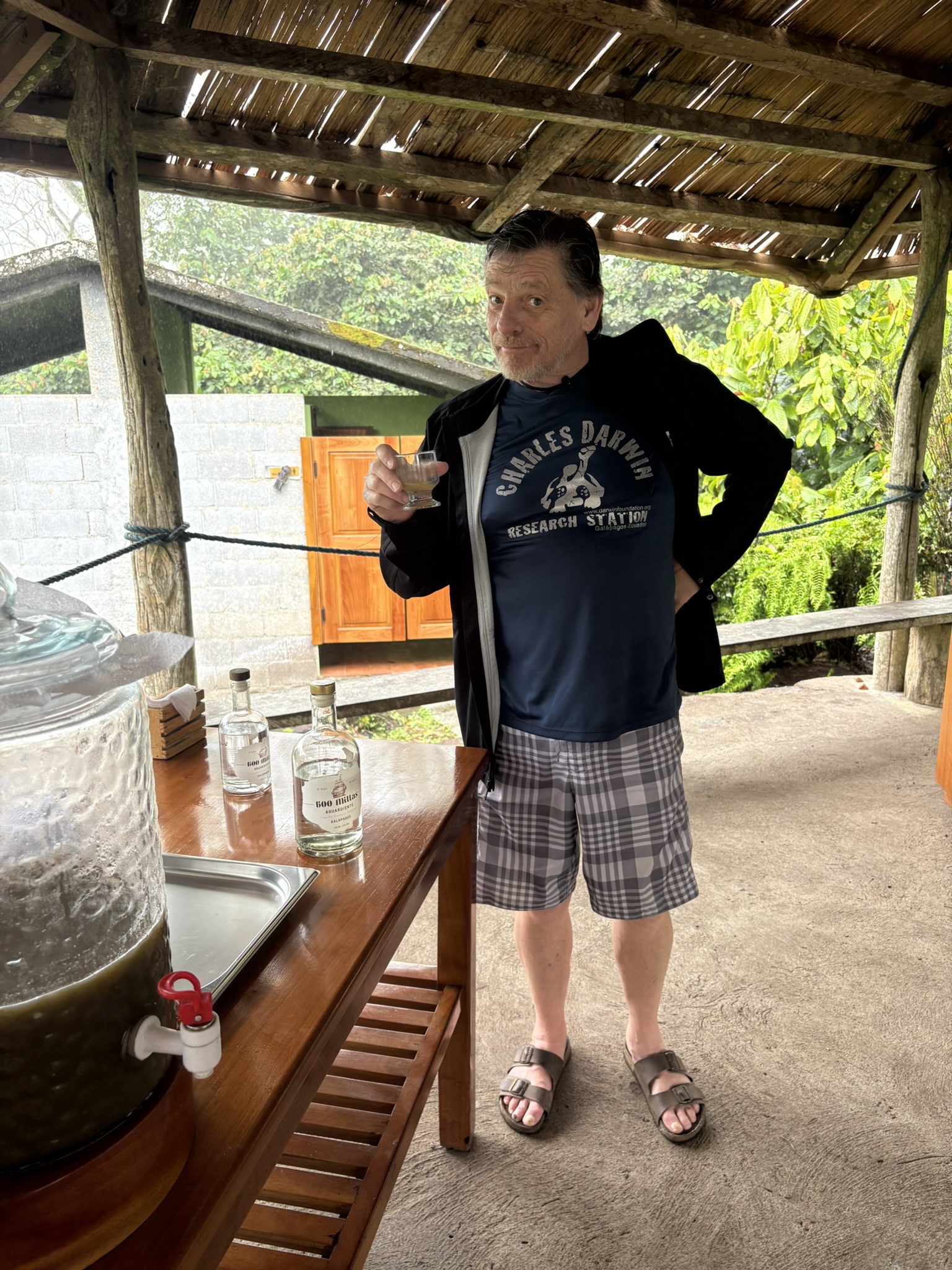
We make our way to El Trapiche ranch to learn more about the local cane sugar and coffee process. They process the sugar cane very much like we process maple syrup, ending up with sugar through evaporation. He also makes moonshine with it. Here Chuck is sampling the moonshine mixed with pure cane sugar.
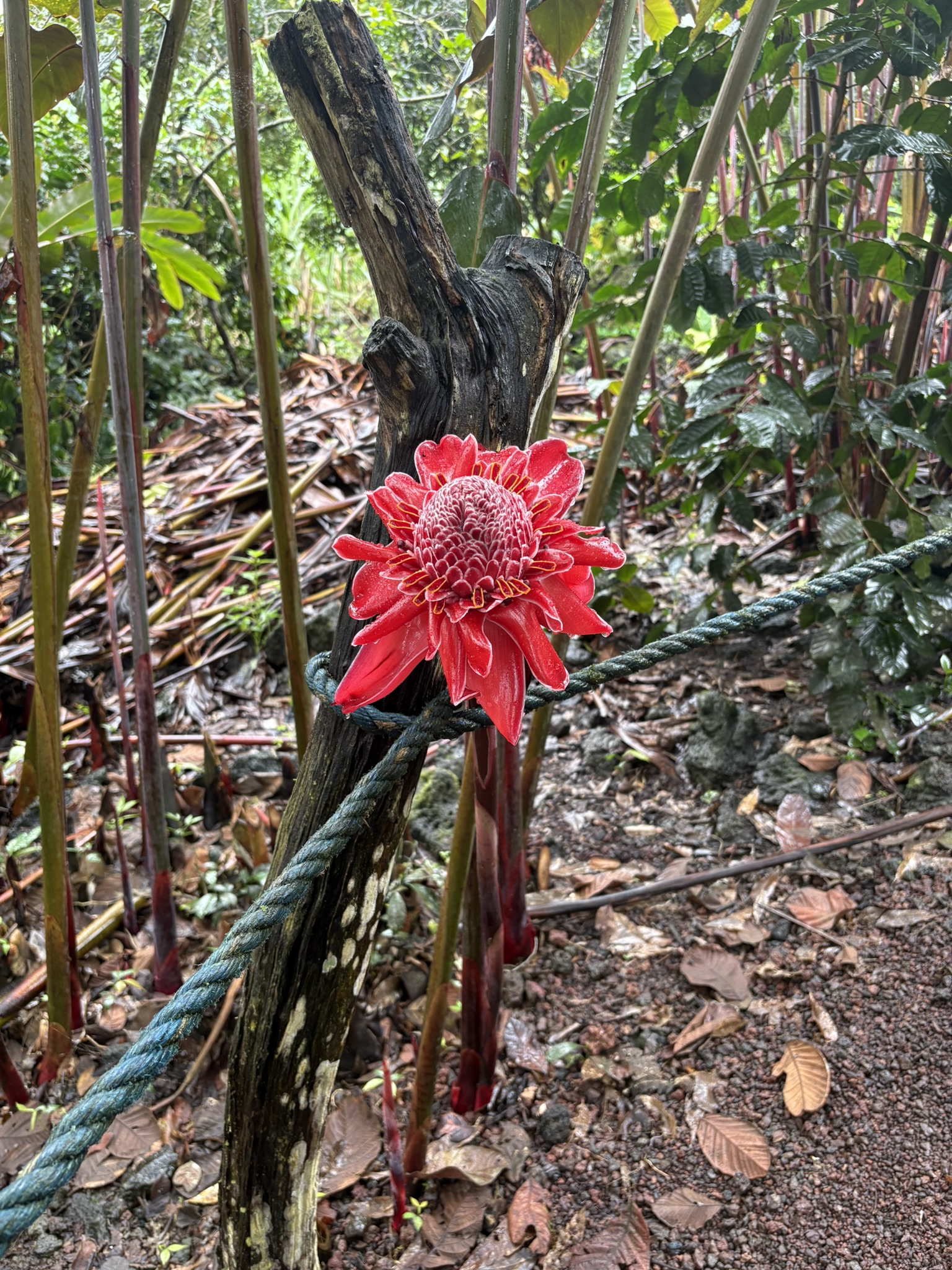
Love the microphone flowers they grow which are not native.
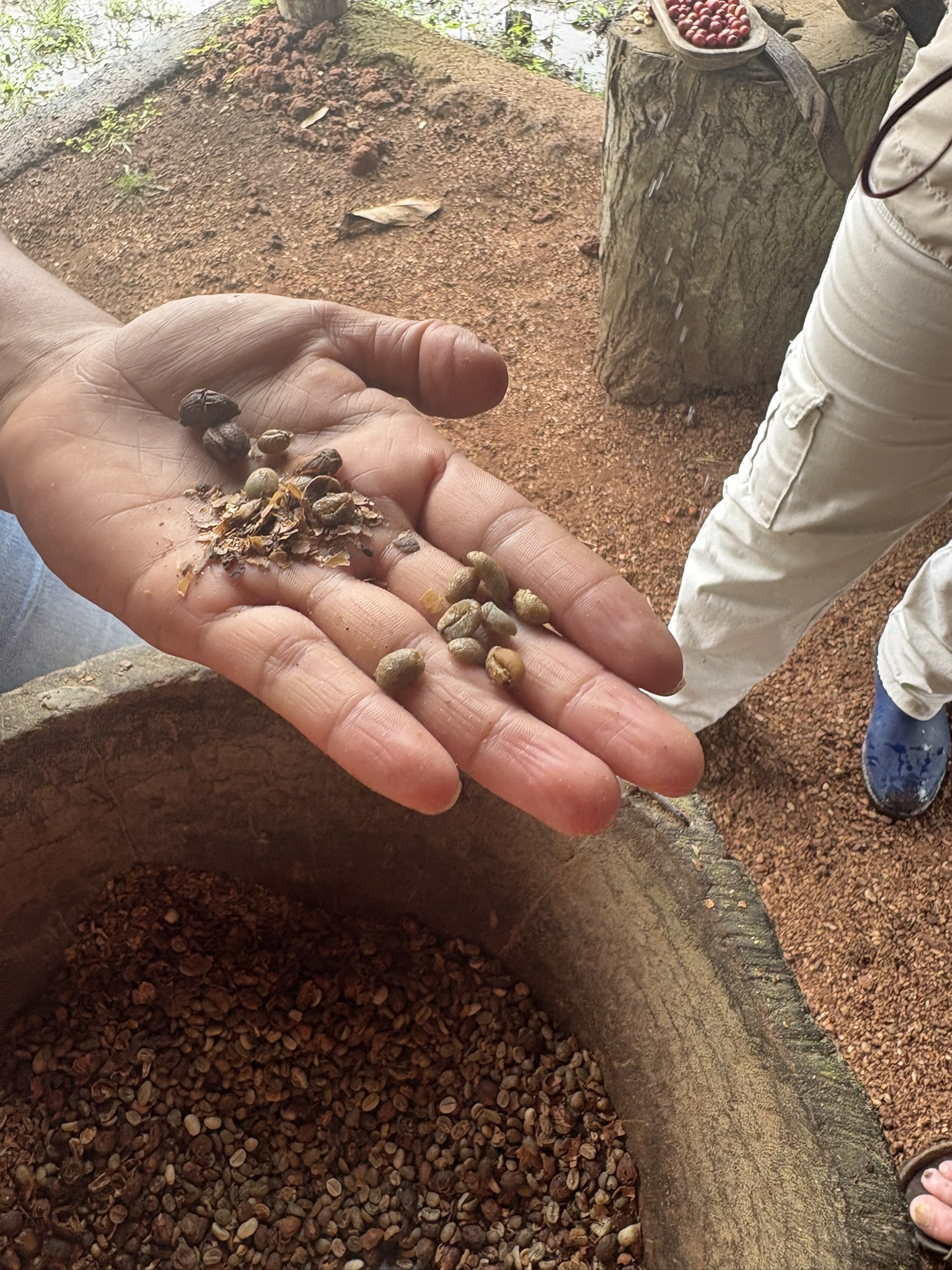
The 3 stages of the cafe bean.
The coffee beans are excellent, we are invited to crunch some with a bit if sugar cane sugar and a small cacao bean. So good – my new favorite snack!
Adrianno owns the El Trapiche ranch, he arrived here in 1950 and is now 85 years old. Everything is harvested and processed by hand and 100% organic, with produces only sold at the ranch.

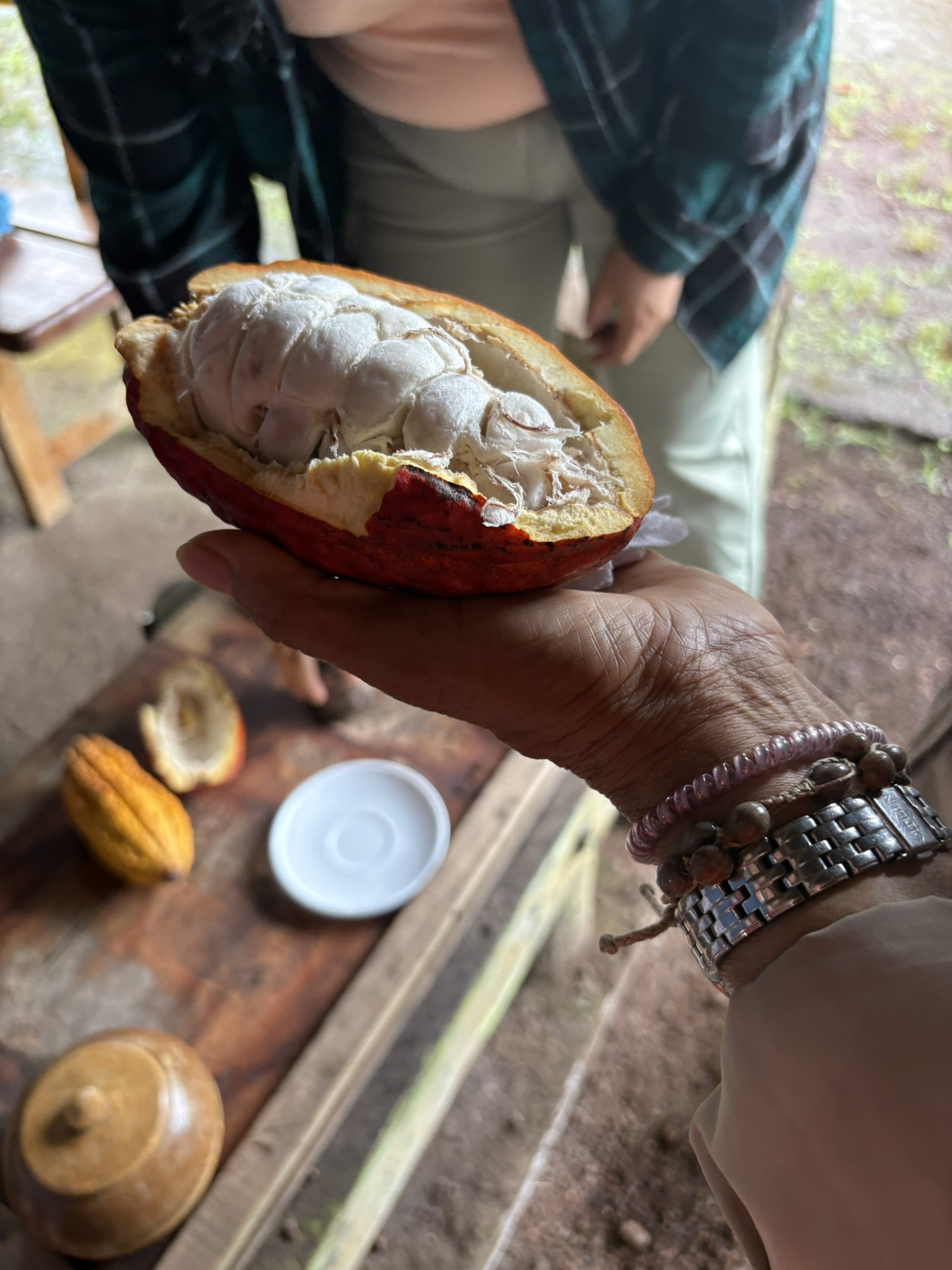
The Cacao beans which we are invited to taste prior to roasting. Tastes like a plum when you are close to the pit.
We see a field with cows and turtles and cow egrets eating side by side. It is interesting that cows, pigs and chickens were introduced by the Spaniards. Prior to that the ecudorian, similarly to the Incas, were mostly vegetarians and thriving.
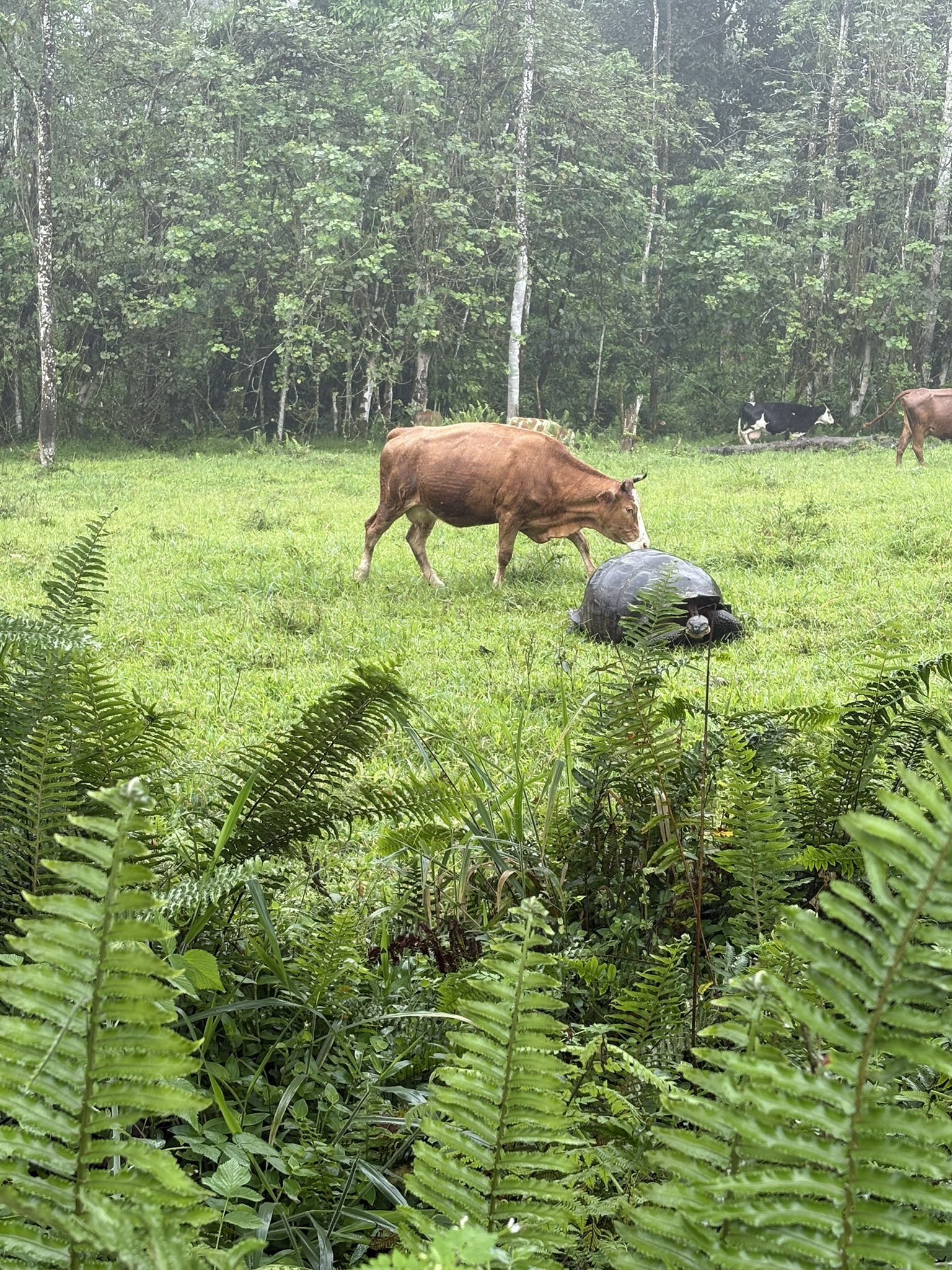
If they are slowly crossing the road, we must wait. During the rainy season they start their 2-weeks, 17 km journey to the dry area because they do not like when ponds overflow and grass is swampy.

12- We visit a lava tunnel. There are several on the island.
13- Over to the tortoise ranch for lunch and to observe some of the biggest ones on the island. The male can grow to 500 pounds. While they like to lay in a pond to rest, their face never goes under water and they must touch the bottom. We were lucky to see so many as the rain season has started.
I was excited to catch one in movement. Most of them are eating and static.
14- The next day, we are on an expedition to Seymour island. We begin with a gentle hike around the island. It is full of land iguanas, here we catch a male eating which is rare. Usually they are like a statue.
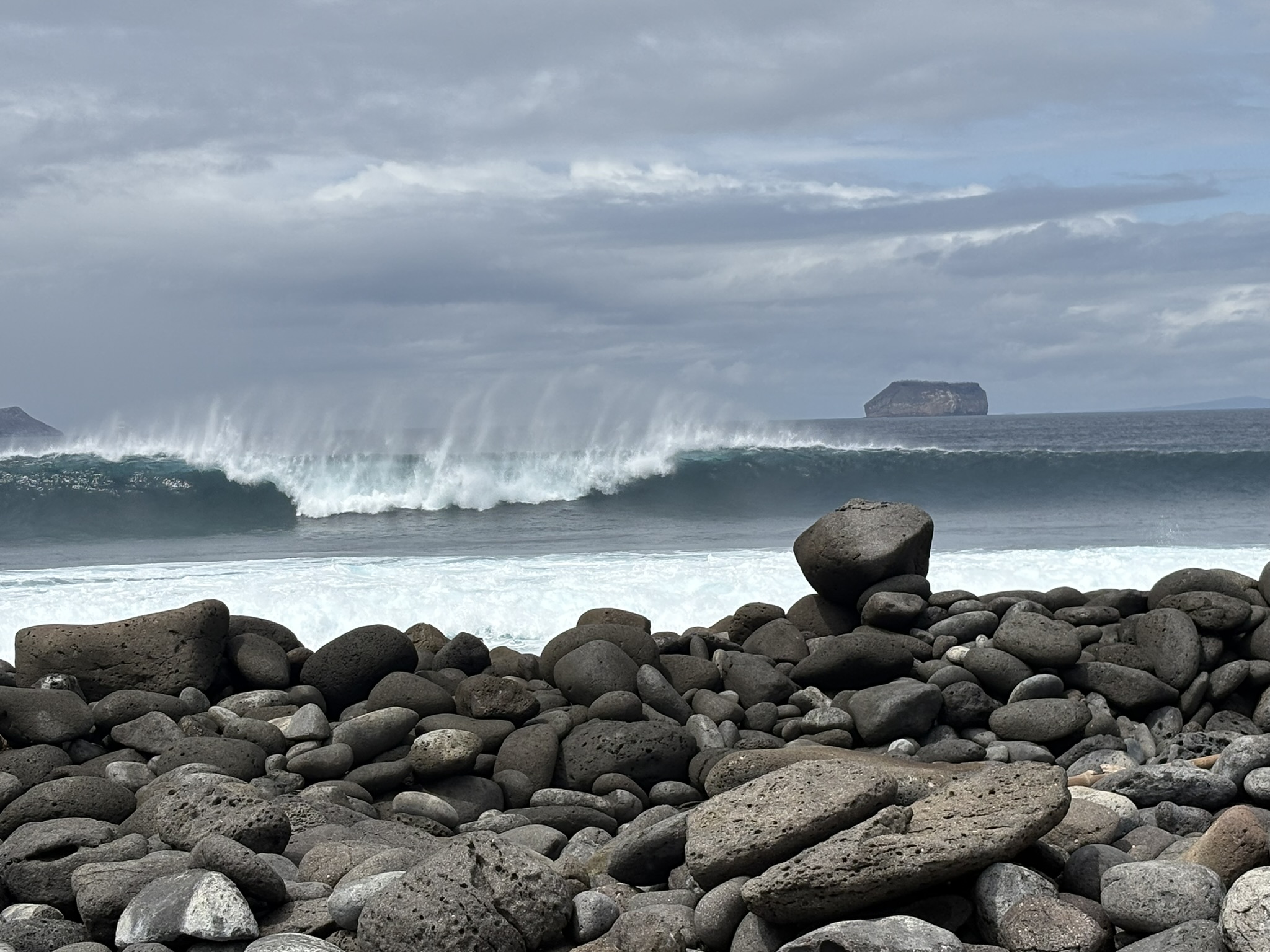
15- There is a beautiful spot where the waves are crashing with many sea lions froliquing.
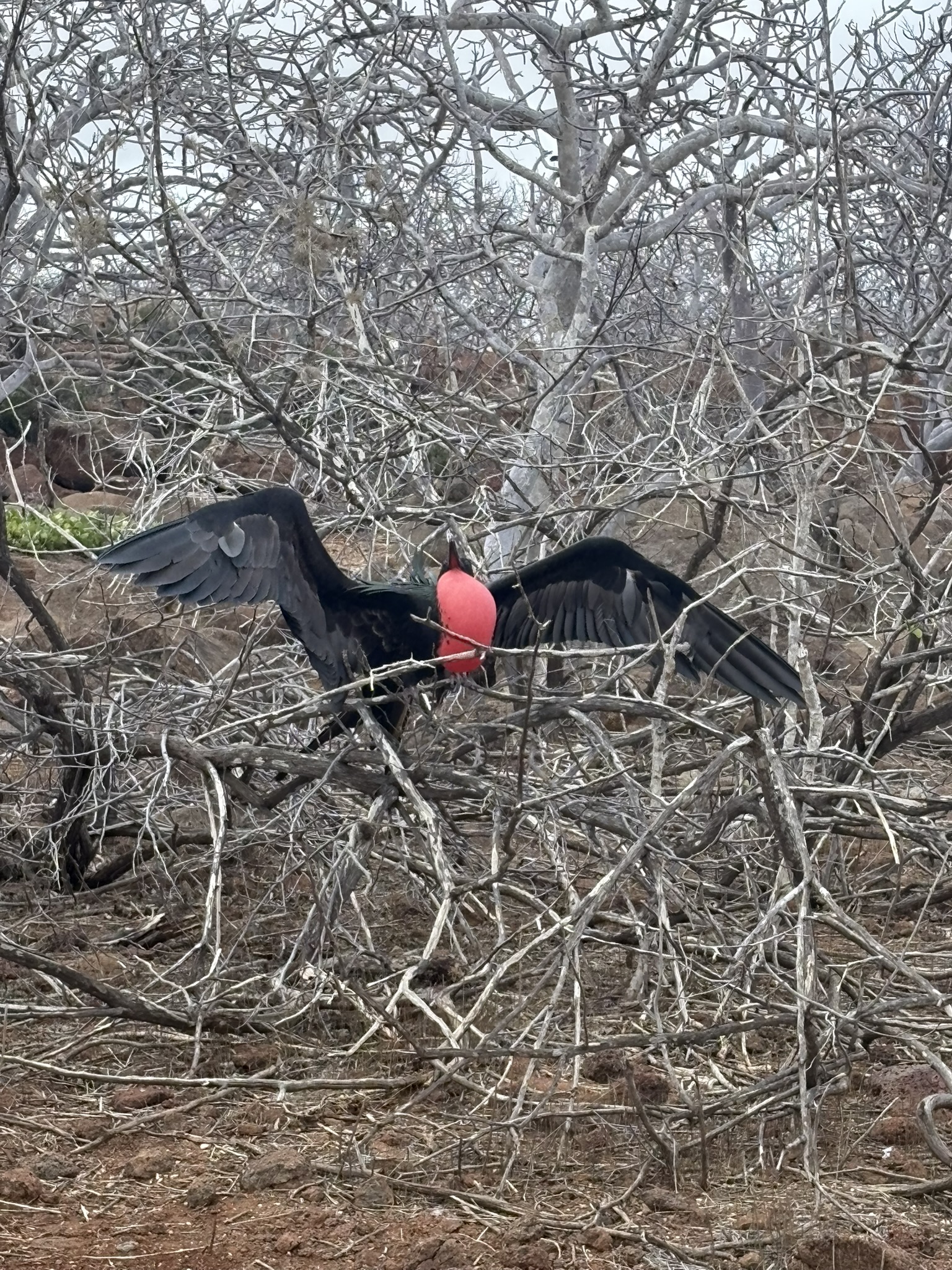
16- But mostly this island is known for being the breeding area for Frigatebird. When they were explaining that the male have this big red pouch to attract the female, I didn’t realize what they meant. They are puffing all right!! They stake their ground on a branch and do their best to attract the female. It is quite the show!
17- we also see cute 6-months old babies.

18- And more blue footed booby – normally they are mostly gone by now so we feel lucky to be able to see a few.

19- Off we go snorkeling again. Ricardo prepares us for seeing sharks. Here they are full of fishes and have no interest in humans. It is hard to wrap our heads around this. But sure enough, we come across a small black-tip shark and then….a group of probably 20 white-tips SHARKS swimming right there below us. Some up to 6feet long. I stay close to Ricardo. Chuck has had enough and gets out of the water.
It is really an unbelievable experience! I curse myself again for forgetting our underwater GoPro.
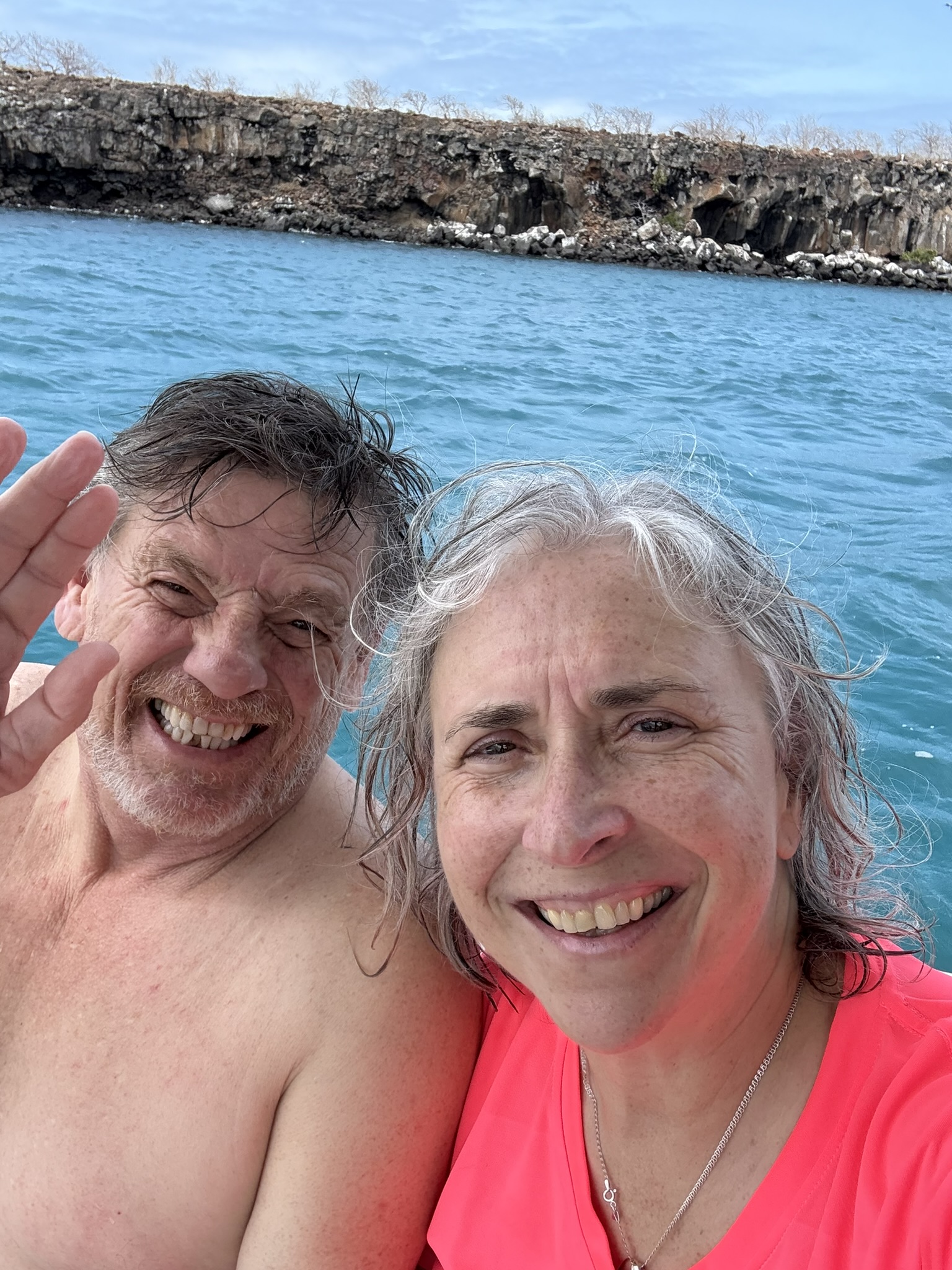
20- There are so many pristine and beautiful beaches here!
21- We walk to the other end of the Main Street to end the day with a lovely dinner at a restaurant overlooking the water. The setting is fantastic.
Tomorrow we leave for Isabella island and more adventures!

Galapagos – Santa Cruz Island, Chapter 3
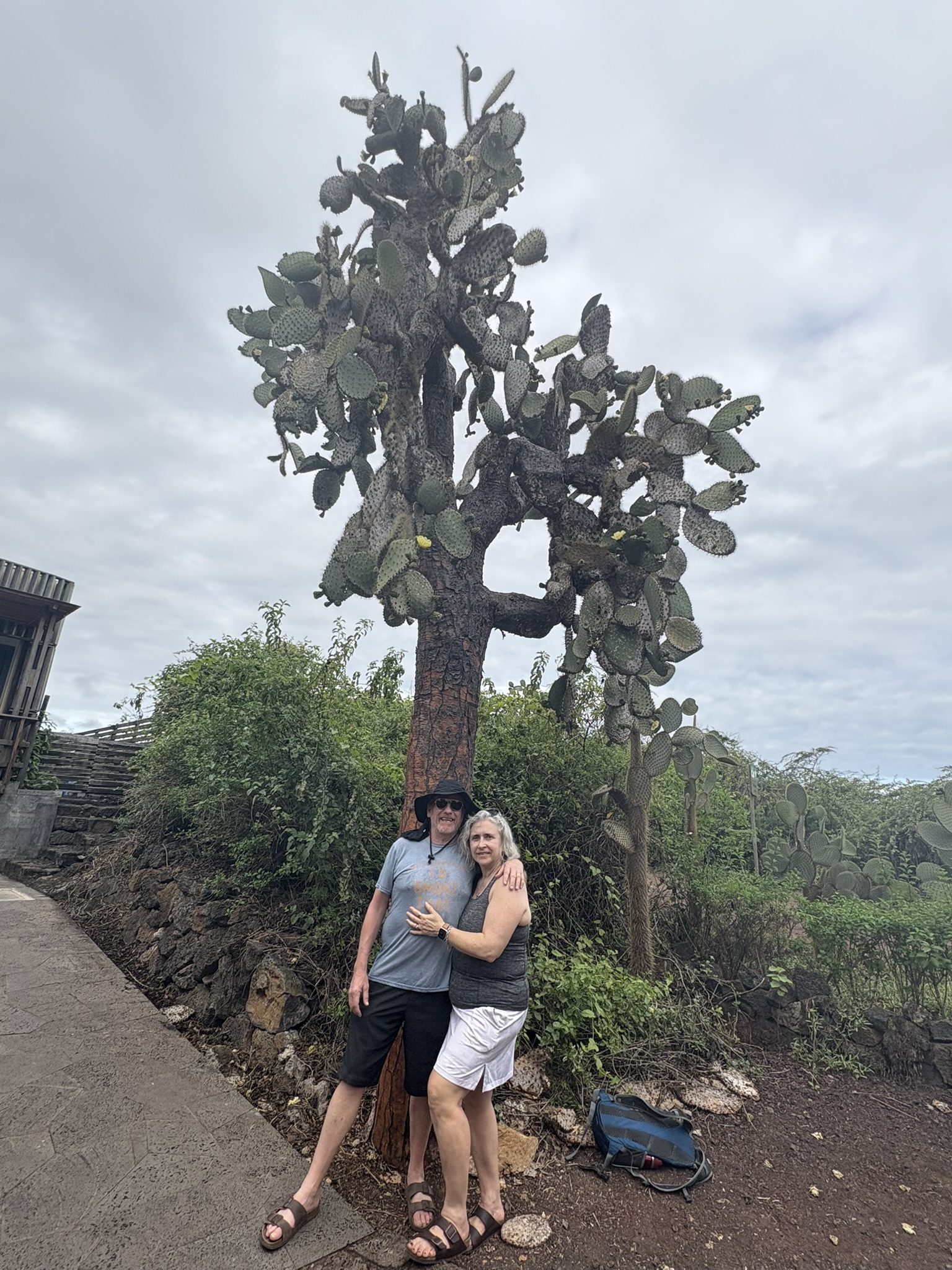
In the afternoon, we are off to the Tortoise breeding center and the Darwin centre with Isabella, our local guide. I am very surprised with the sizes and number of prickly pears cactus, indigenous to the island.
It is so interesting to learn of their efforts to rebuild the turtle population that was depleted to 20,000 across all the Galapagos in 1960, due to pirates and fisherman that were using them for food and then for oil on the mainland. Due to their efforts with incubation and breeding, they now count more than 60,000 tortoise in the islands. There are 15 species but 4 are extinct.
On day 1- our travel agent reserves a table at Bahia Mar for our first day, a lovely restaurant with ocean view. It is delicious and we enjoy watching the many iguanas sunbathing and the red crabs that we will see very often.
For example, they were successful in bringing the only remaining 13 female and 2 males from on if the islands many years ago and breed them to 2000 eggs the first years. They then reintroduce them in the wild once they are 5 years old because at that age, their shells are hard and they no longer have predators. Tortoises reach puberty at 25 years old. At the centre, they only feed the babies 3 times a week so that they continue to find their own food the other days to be better prepared to go back.

We see small 1 years old babies to 50 years old adults that are here to breed and then go back. We learn about the many small lizards that are critical for the cycle of life here as everything eats them as well as the difference between the shapes of the shells of the tortoise depending if they are marine, low feeding or high feeding (with long neck that do not retract into their shells).
A small local beach near our hotel teeming with life – the iguana leading the way.
Same type of iguana but a male showing off its colors to attract a female.
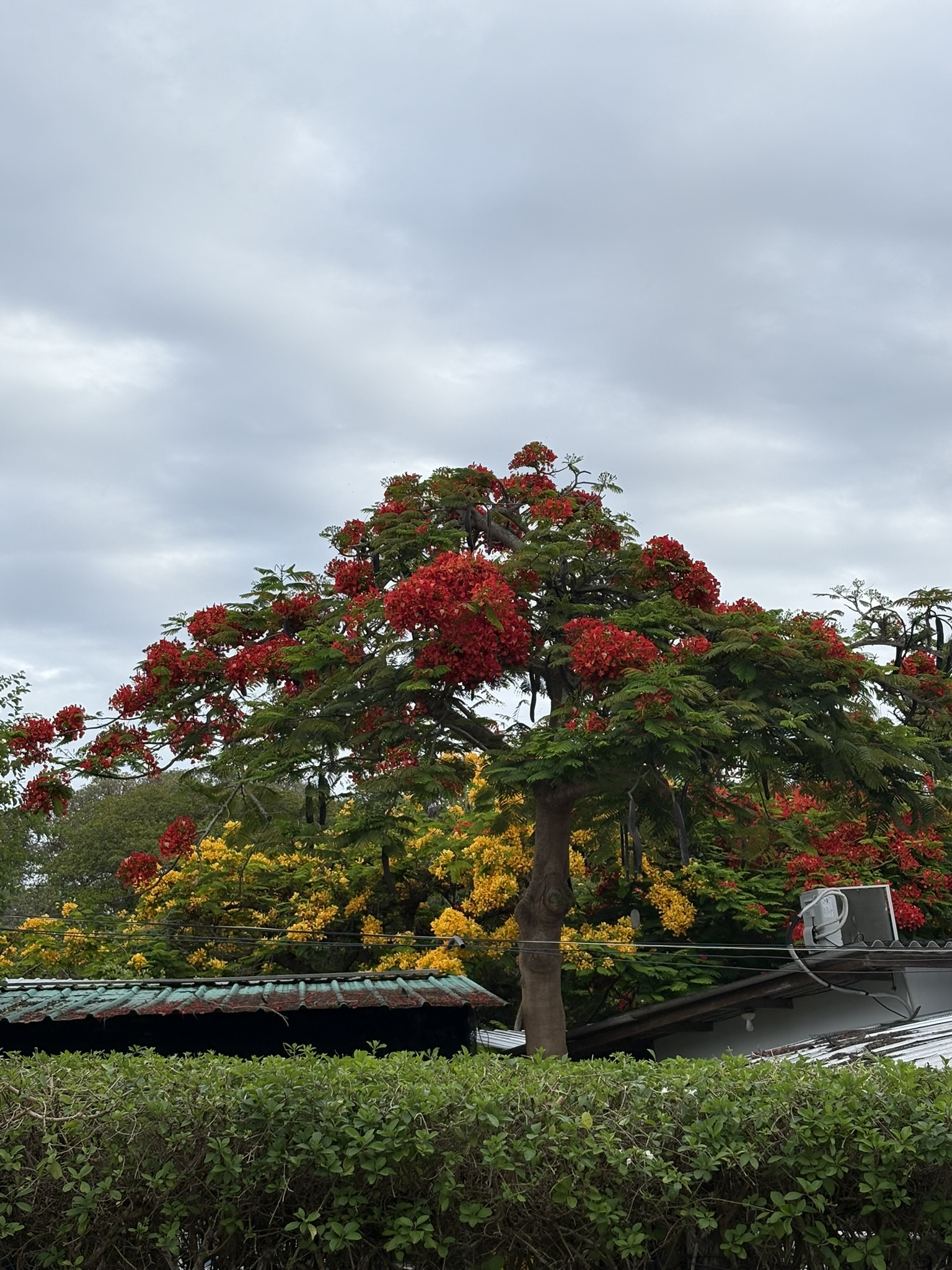
Isabella points out many vegetation including the glorious red and yellow Flamboyant that originates from South Africa but is not invasive. There are beautiful native yellow hibiscus also and the tree that is used to make Panama hats (which are really ecudorian). This tree only grows here. She tells us that the only indigenous flowers here are either yellow or white.
Getting ready for our day trip to Bartolomé and Santiago (hoping to see penguins!)
We board a nice yatch with a small group, including 5 ladies from Iceland who have knows each other for 40 years and have started travelling together. How cool!!
It is a 2 hours cruise and our first stop is bypassing another uninhabitate island to learn about the local sea birds. Here we catch a Frigatebird in flight (known to be able to fly at sea for 2 months). On the way we see many dolphins swimming very near the board as well as turtles, sea lions and one shark. The sea is full of life here.
Arriving at Bartolomé, we disembark and must dislodge a large sea lion sunbathing on the steps. He isn’t happy to be disturbed from his siesta 
Filipe explains that the difference between seals and sea lions is that the sea lions swim but moving their front limbs and using their back shoulder which requires a lot of energy, whereas the seals use their tail which is easier. Therefore sea lions are always exhausted  which is why they are always lounging.
Our guide is super interesting and knowledgeable. I will capture a bit of the info he shares here.
We make our way up to the summit on a path built of wood with flat sections and stairs. Along the way our guide Filipe, tells us about the formation of Volcanoes, and more specifically the Galápagos Islands. We learn that St-Ferdinand is the youngest one at 500,000 years and is the one sitting right on top of the magma chamber. The oldest ones is in straight line to the east at 5 millions years old. In between, we have Isabella where we will go towards the end of the week and Santa Cruz where we are staying now. We learn about “tuff” which is the packed lava we see everywhere and the lava cactus. This cactus is about 100 years old because of its small size but there is a large one on St-Ferdinand that they estimate is 800 years old and is 6 feet wide. As their branch die and decompose on the ground, they create the condition for more vegetation to come.
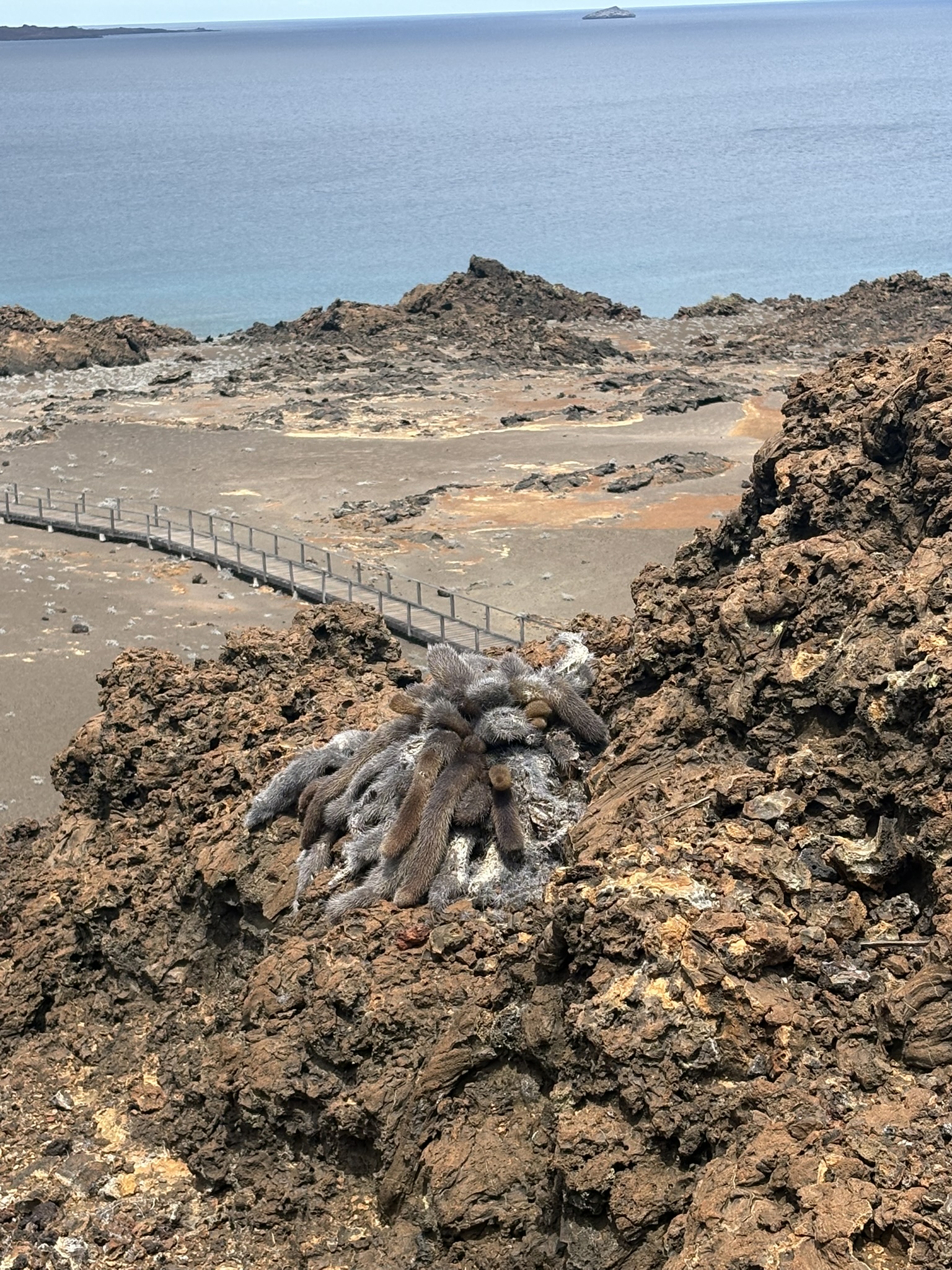
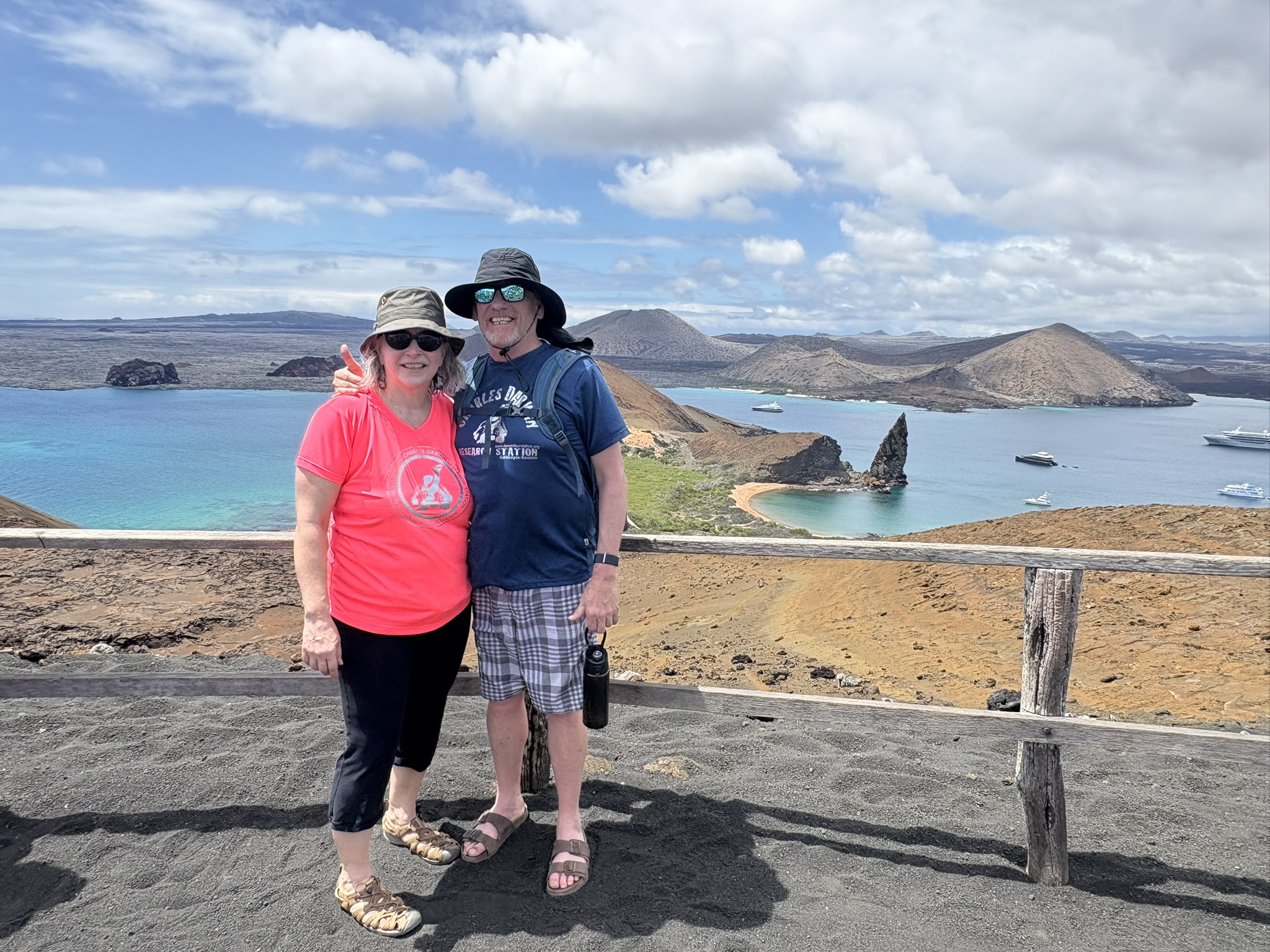
The view at the top is very spectacular, with turquoise water surrounding us and the iconic Bartolomé Pointy rock.
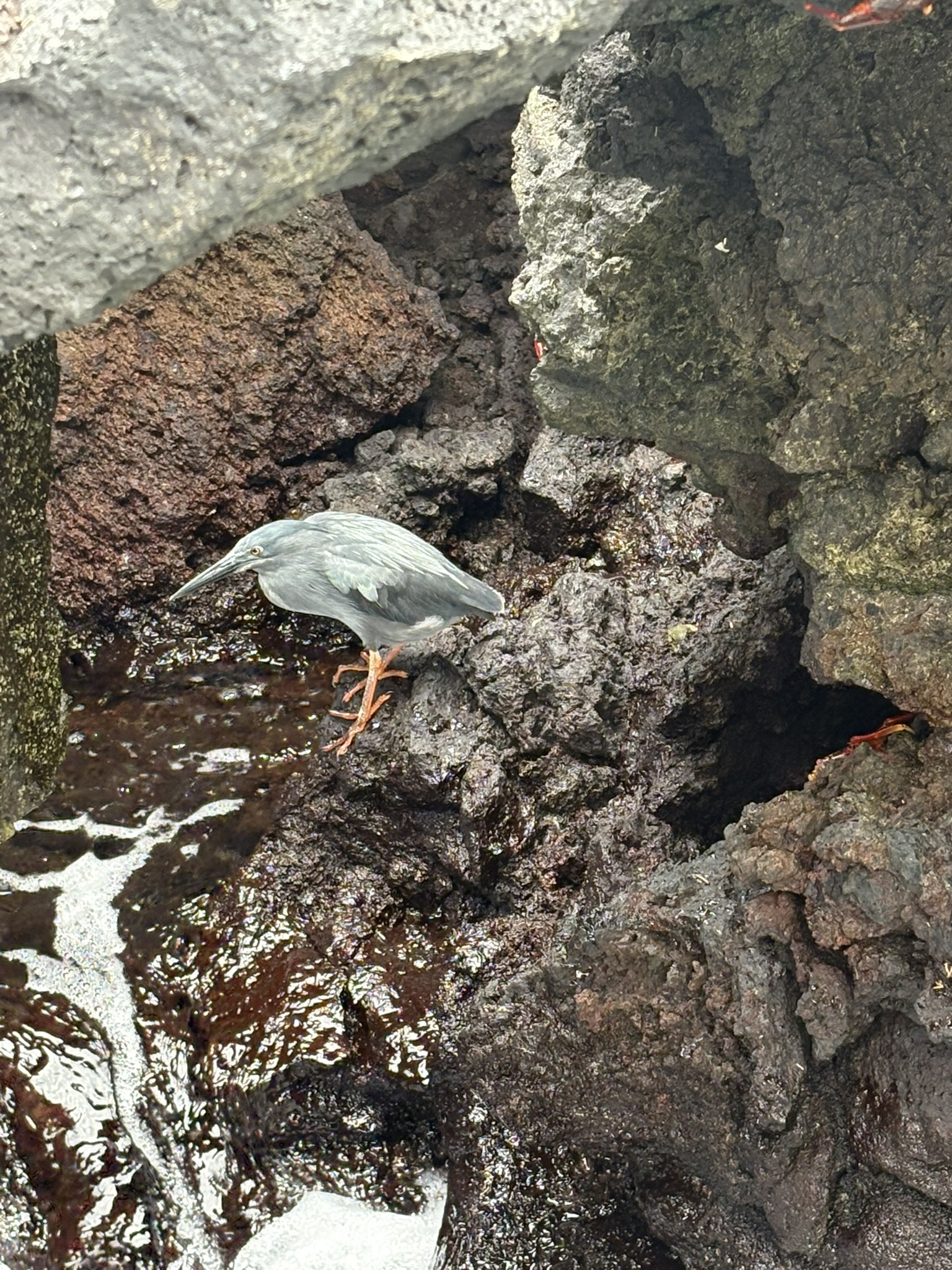
We come back down and discover a lava heron nestled in a hole in the rocks besides the stairs of the dock.
Our sea lion is there swimming around waiting for those darn human to leave so he can get his spot back. As soon as there are only a few left, he makes his way up and there is nothing Filipe can do!
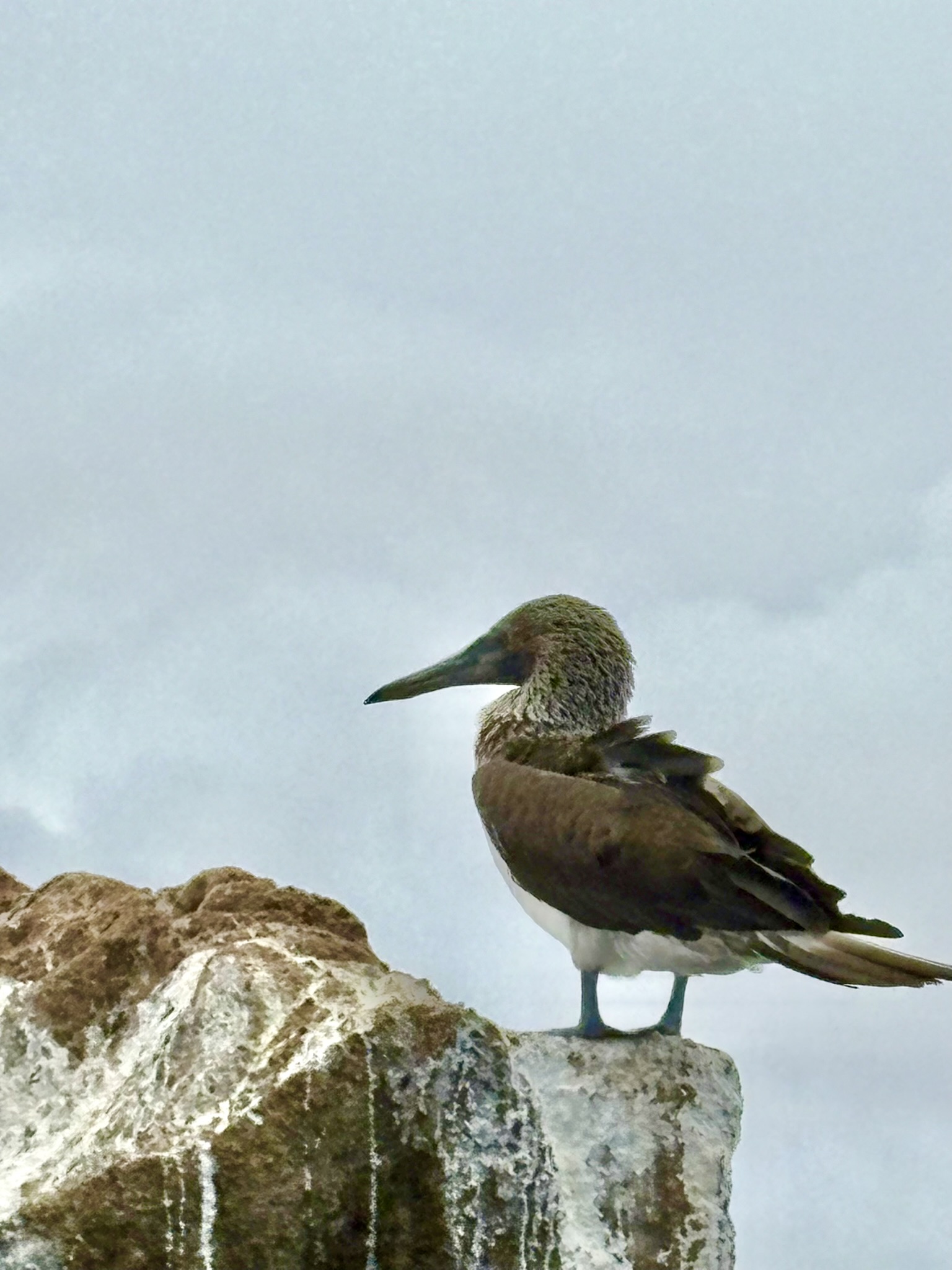
Onwards to the local small penguin resting spot and the white beach in Santiago for snorkelling. on the way we find a blue footed Booby handing out with 2 playing full sea lions.
Once organized with our snorkeling equipment in the water, we are treated to a rainbow of colors – the fishes we see are amazing! Many “Nemo” orange fish as well as blue, yellow, red, purple, green etc…, my favorite being the bluechin parrotfish both make and female. Also urchins and then all of sudden, a PENGUIN swimming right besides us. Maybe 2 arms length from me! So cute and again so oblivious to humans. The one swimming near me with is more brown than black identifying him as a juvenile. What a treat!!
Back in town we walk to an excellent restaurant and Chuck orders a meal of « deep fish sticks ». It is sooo delicious and huge!
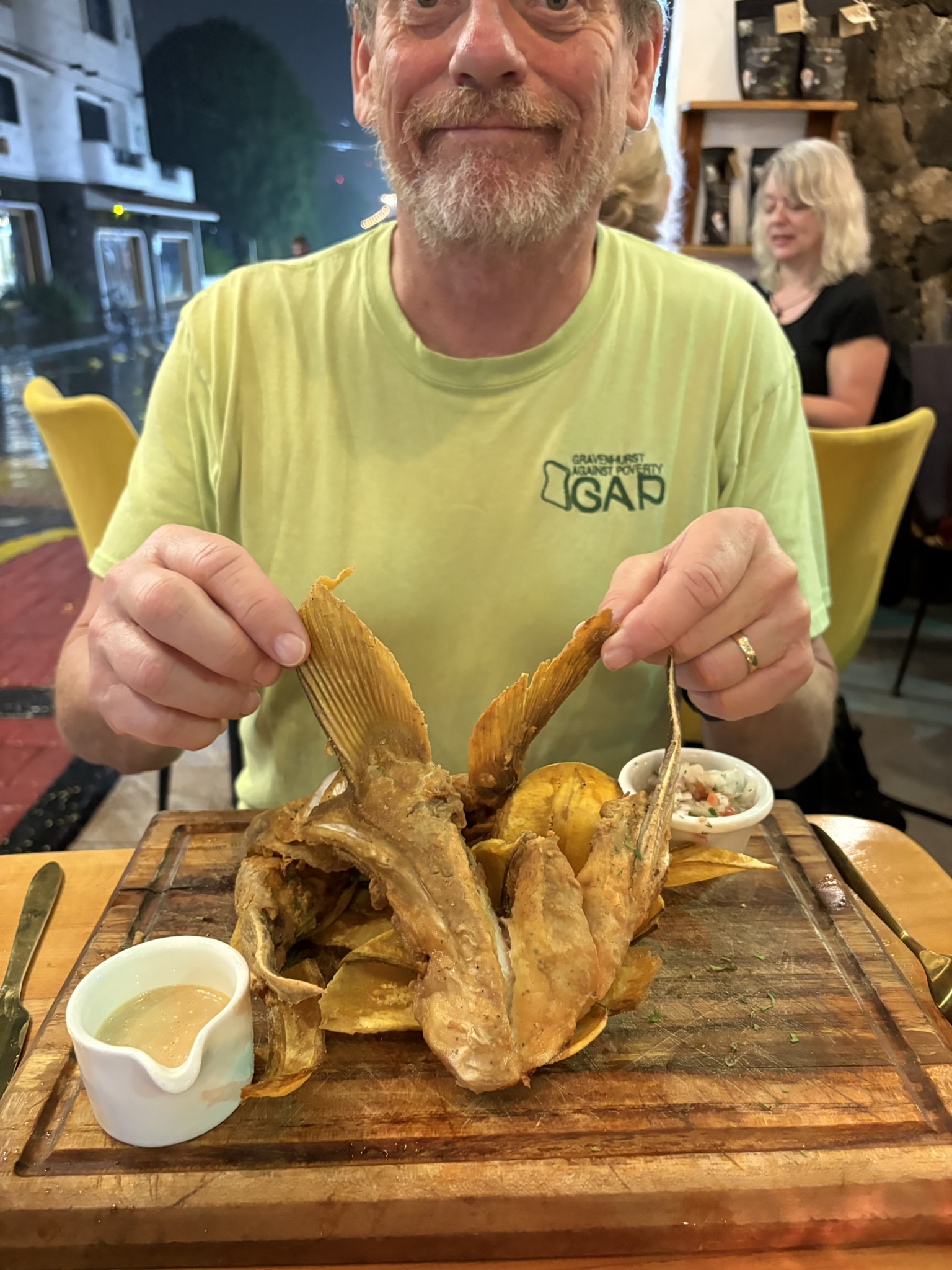
Fabulous first days in Galapagos. Can’t wait for the rest of the week!

Sacred Valley, Peru – Chapter 2
Machu Picchu day!!
This beautiful ancient city has been photographed thousands of times but I can’t resist taking a bunch of photos.
We meet our guide in line for the bus at 7am that will take us there in time for our 8AM arrival.
There is a crowd of people on that road as far as we can see….and it is the low season! She tells us in high season there are 5000 visitors a day there! We begin our visit and take many pictures from the various viewpoint.
We learn so much about the Inca and why they built the ancient city there. We admire the platform for agriculture as well as their experimental platforms. They had so many variety of corn and potatoes!


A view of the valley. I find the fact that they cared about the number of degree of inclinaison of each wall depending on the sun position and the status of the inhabitants, that they had an area for a school, that they had a water canal system and more is so amazing!
Good on them for abandoning it when the Spanish invaded to ensure that they wouldn’t find it. Again that story is impressive as well as how the story of it was mantained by the local tribes.
What a treat! We feel very privilege to have had the opportunity to visit it at low season on a bright sunny day.
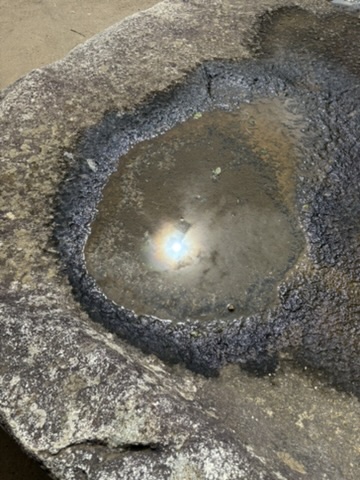
We are also very lucky to be by the reflection pool when the sun was reflecting exactly in it.
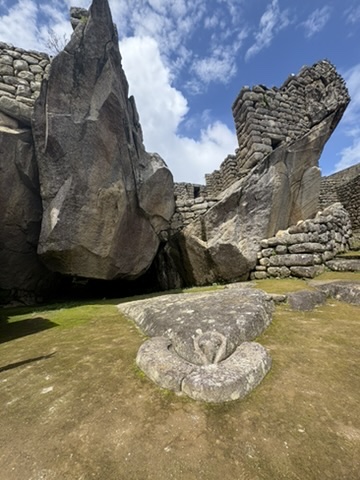
My favorite temple is the Condor Temple where they used rocks that were already there representing the wings and the body and simply added the head.
Humantay Lake: We have to rise at 4:15 AM to be able to meet our hotel pick up at 4:50  We then drive for 2 hours in a minibus type vehicle to the first stop – Mollepata – where we have our breakfast. We then drive an hour on a road that looks so dangerous so many times! Little mounds of dirt to act as guardrail, erosion can be seen here and there and OMG, the cars are actually going to face
Chuck can not look. The valley below is so far but the views are of course stunning. I manage to take a few pictures from the rocky, moving car.
Once we arrive at base camp, we prepare our duffel bags, use the washroom (unsurprisingly again with the squatting) and start our ascend with our guide Owen. We will move one step at a time from 3500 metre above sea level to 4200 sea level.
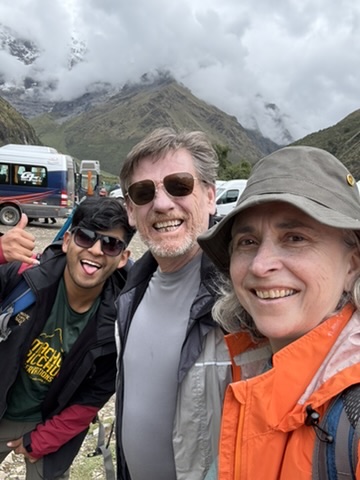
Many horses are available for rental from the local families. Owen informs us that there are 10 Inca descendants families living inside servicing this campsite.
There is a small house at midpoint but we can not see it at the bottom. We hike for a short while on relatively flat surface but quite quickly, we start feeling the incline and the altitude makes for laboured breathing. Owen offers us “coca” leaves to roll and put inside our cheek and some rolled up with another black substance (video). We also use the water of Florida which is alcohol with many local herbs that marinate in it. This is something you put a teaspoon in your hand and clap your hands and then smell heavily to open your lungs. You repeat 3 times. We are game and hope it will help.
I find it hard to breathe. I am offered a horse several times by Owen but I really want to attempt this hike myself. I begin a count of 100 steps before stopping and I try to stick to it. Stopping long enough to catch my breath. We make it to midpoint in an hour which is what they look for so I’m pretty happy.
We begin the second half with a short section that is a bit less steep and then move up the side if a hill that we have to go around to get to Humantay Lake.
I continue with the same pattern and Owen and Chuck stop with me and are very encouraging. Chuck struggles through his ki foot pain and is proud of making it as well.
Once we turn the corner and arrive at the lake, it is quite the view.

It reminds us of Lake Louise but feels like the huge Humantay mountain behind which reach more than 6000 metres above sea level is bigger and more majestic as a backdrop for the lake. We take many pictures and hike to a rock for a better view. My legs are very sore and I am glad to sit. Chuck’s foot problem is starting to act up. While my knees are holding up, I can certainly feel them.
We start the descent which is of course much easier but harder on the knees.
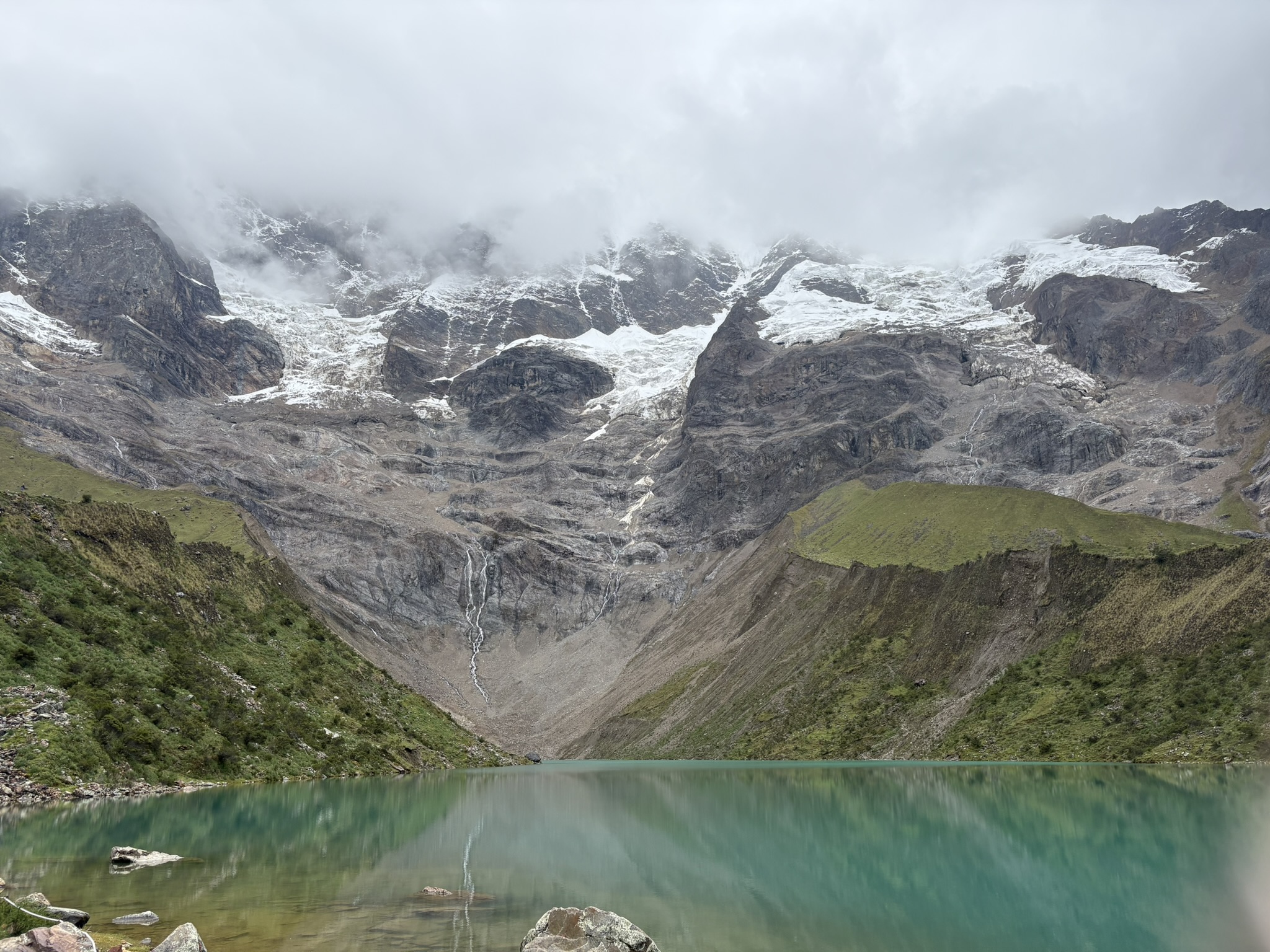
It takes us an hour to go back down but it is now raining and it is getting slippery and cold. Once we arrive back on the outside of the camp, we make a left turn to go back up an “Inca ramp incline” back to the overnight camp. This feels harder and we are really done.
We make our way up to the dining house which is perched at the top because of the amazing view of Salkantay mountain and Salkantay pass.
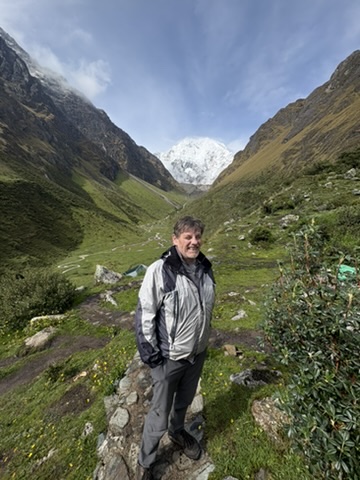
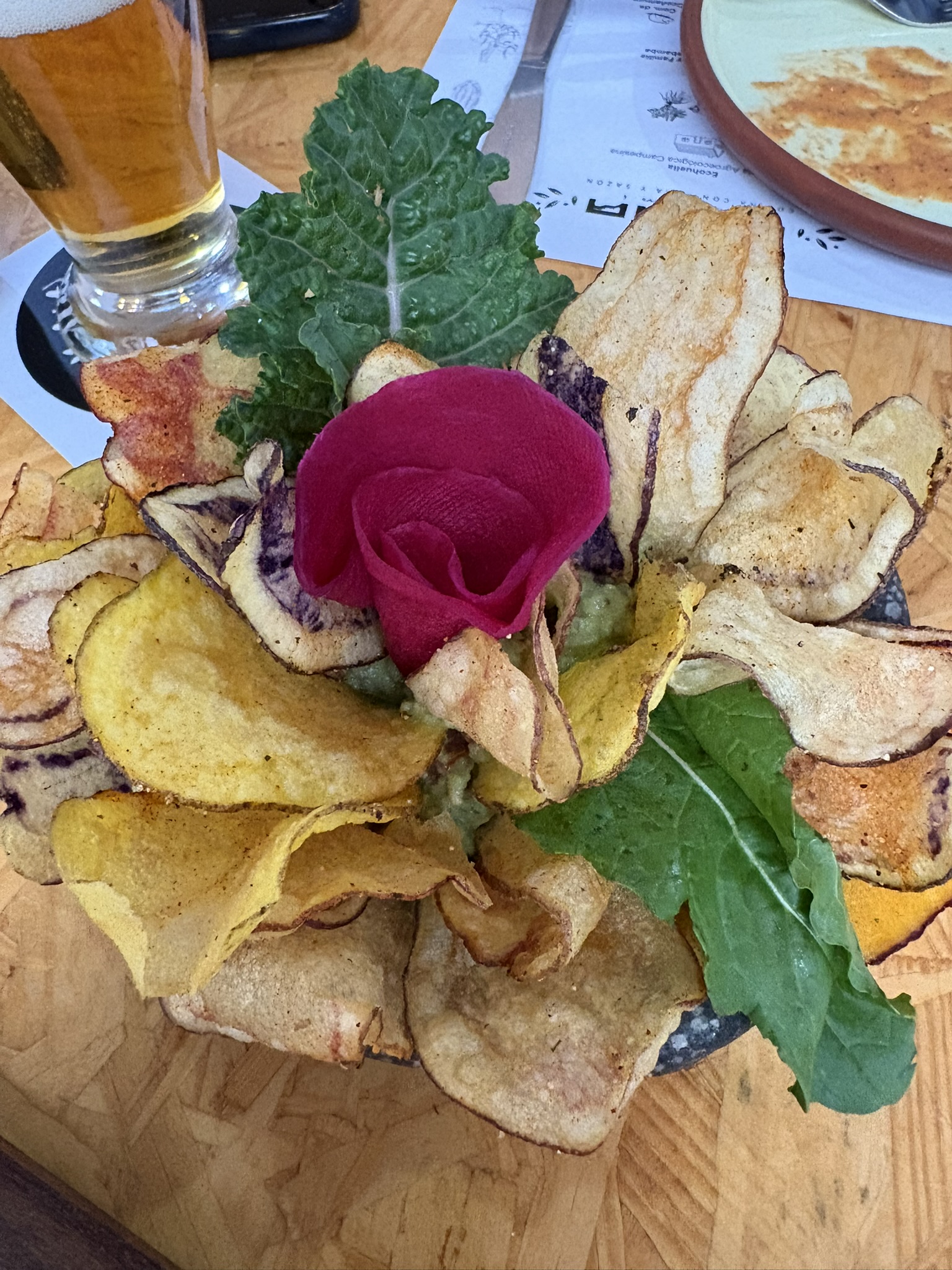
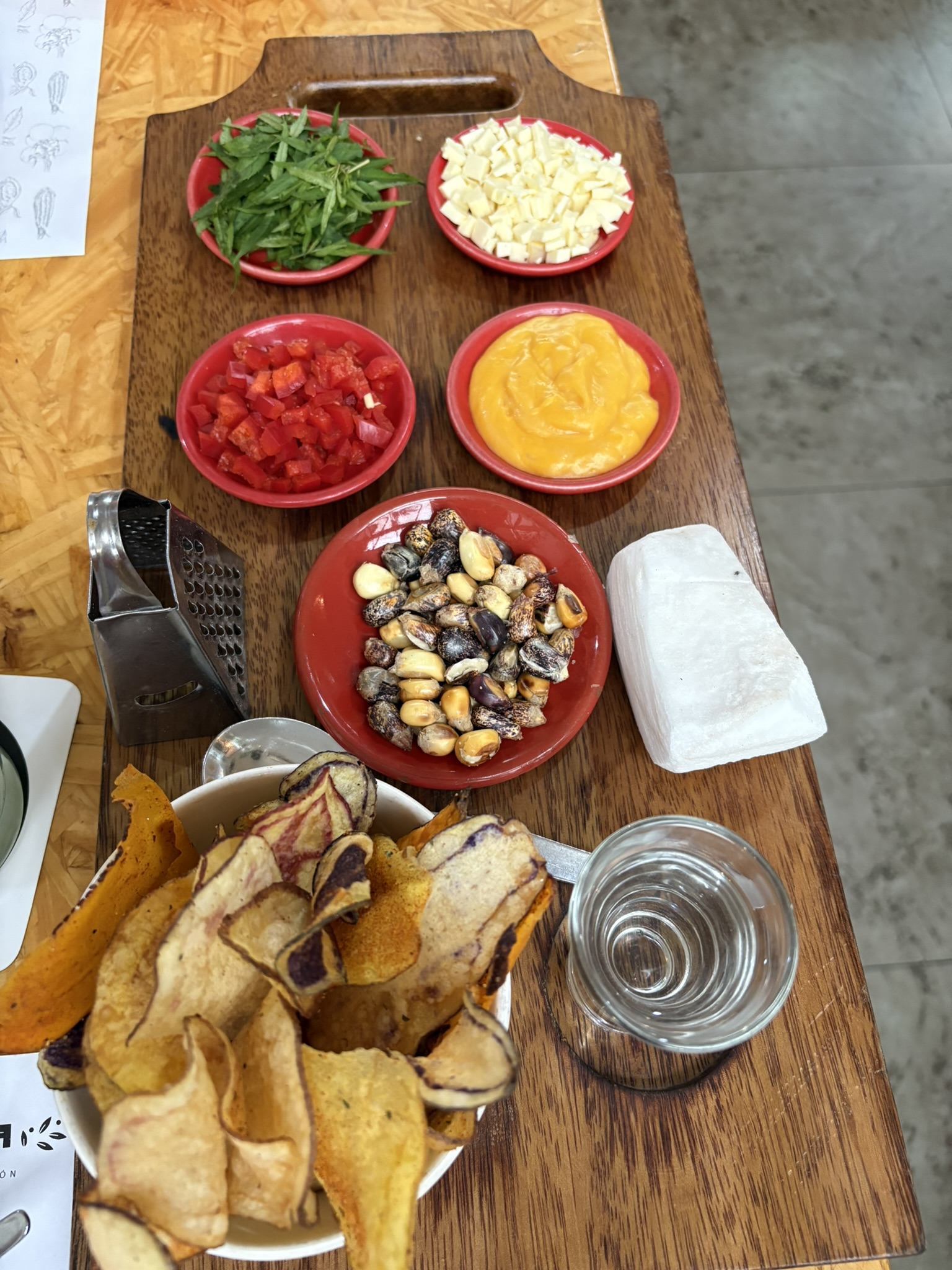
The next day we make our way back to Cusco early. Our marvellous travel agent, Ygor makes a reservation for us for lunch at a restaurant called Nuna Raymi. A wonderful farm to table restaurant whose mission is to support local indigenous organic farmers and offer real authentic Inca traditional food. The food was fabulous and the staff great – a must do in Cusco.
We walk to Plaza San Blas in the rain but walk up the steps anyways to take in the view of all of Cusco. I can only imagine what it would be on a clear day.
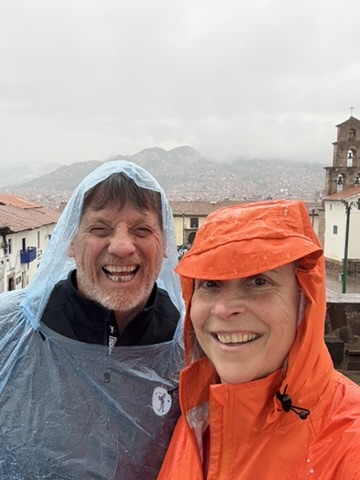
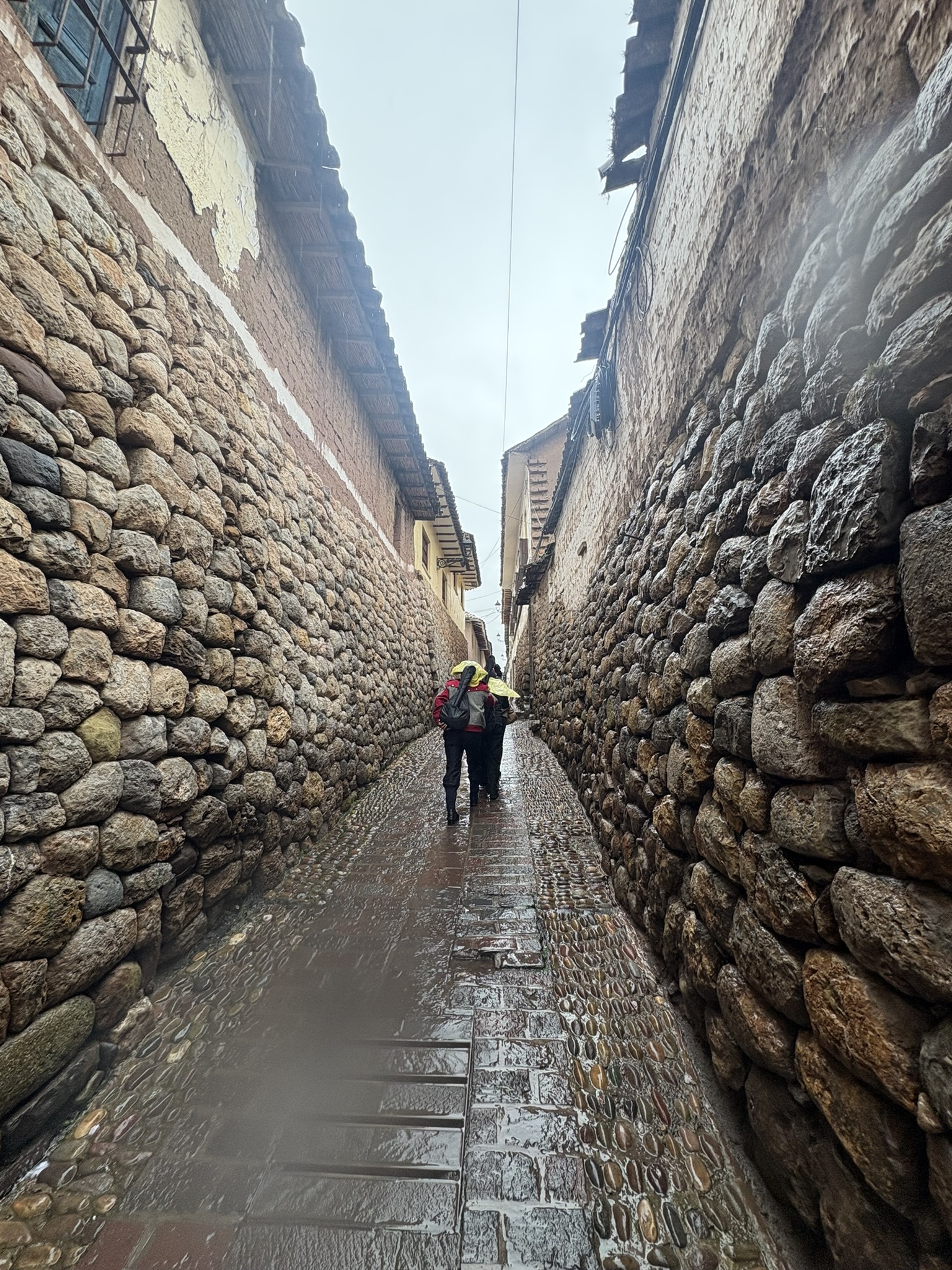
 Final thoughts as we leave for the Galapagos island today
I was surprised by how few people speak English in such a tourist area. Owen explained us that for Inca- descendant, their first language is Quechua and then they learn Spanish. Both languages are very different so learning yet another completely different language like English is difficult.
I am very intrigued with the apparent absence of discrimination between Inca descendant and Spanish or other descendants. They seem to be completely integrated. Something I want to understand better.
While they grow coca leaves in large quantity, farmers are only allowed to sell leaves and this is quite rightly policed by the government. Consequently, they apparently do not have a drug problem (cartels etc)
We stayed at boutique hotels and were pleasantly surprised. For example in Ollantaytambo, our hotel is a family business and our host, Alex, is the only one who speaks a bit of English so he is our contact. We enjoyed there an excellent rich coffee made from local beans, very smooth and no bitterness.
All our guides were Inca-descendants at least in part and were clearly very proud of their heritage. They are passionate about sharing their heritage, languages, food etc…and refer to the Spanish invasion as the colonization time.
While we only visited the sacred valley, there is so much more to this country – coastal region, desert, jungle and highland (mountains). Consequently their agriculture is very varied and we feel we have only scratched the surface.
We loved it! 

Trip to Sacred Valley, Peru – 1st chapter
January 5th 2024
Our trip to Sacred Valley in Peru – 1st chapter
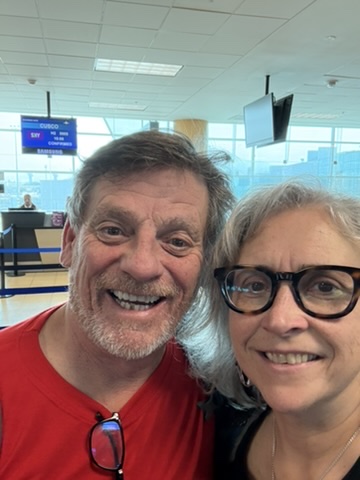
1- Chuck and I boarding in Lima
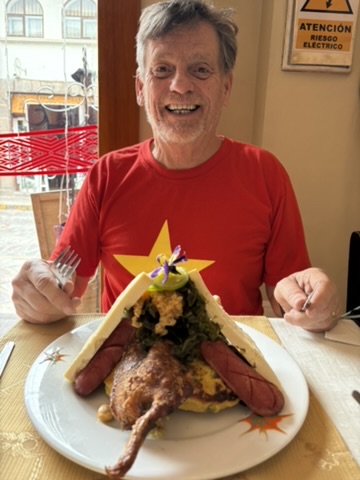
2- Chuck having his first typical local meal – basically all kinds of meat with a fat corn pancake and the best Andean cheese ever!
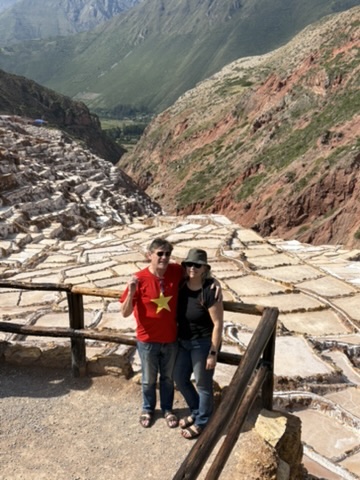
3 + 4 – the Maras salt mine – such an interesting place. These platform “mines” are very interesting in their ownership structure as well as the method to extract salt and the source of the salt water.
The salt water comes from pockets in the earth. Their origins is a source of many legends but we are far from the sea so it is very odd.
To extract the salt, they flood the platform twice a year for 3 months beginning in April. Each platform receives 30cm of water and the sun enables the evaporation. From time to time the family will move a salt layer that accumulates at the top to enable the rest to be evaporated. The end result is 3 layers of salt, the top white one is the best for domestic consumption (the flower of salt), the next layer is pink and is for domestic consumption as well. The next level is black-ish and is sold to companies and used for commercial purposes, one of which is ….. processed food  .
.
The platforms are all owned by local families going back hundreds of years. Each family may own 5 to 30 platforms. They formed a cooperative that manages the process and takes care of sales. The families can only sell their platform to another family that lives within the surrounding area. They are now expanding the platform to the end of the valley and now those who live in those areas will own the new platform. The government protects this ownership structure and no large company can ever own the platforms.
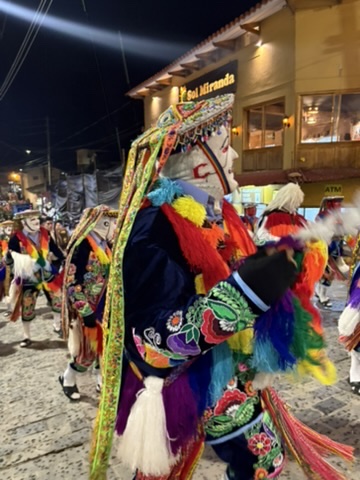
5- we arrive in Ollantaytambo for a catholic celebration with parades, music and dances. This is a very safe city mostly populated by Inca descendants. Very fun party that will last 4 days.
6 – In that city, there are Incas and pre-Incas ruins. There is an intact pre-inca temple dedicated to water where a canal bring water from the nearby Andes mountain with a window above facing the sun.
We discuss these ancient civilizations include the very first one more than 5000 before JC named Caral (north of Lima) and we still see their signs “Chacana” carved in one of the stone, adopted by the Inca. Jose explain that the Incas method to conquer was to assimilate the other civilizations by their princes or kings marrying the princess from the conquered. These tribes also all believe in a creator of the world as well as many gods related to nature like the sun, the air, the water. The Incas incorporated the names used to refer to the creator in how they named him in their religious ceremony. So the name they used became a combination of all those names. They also always offer to exchange their knowledge for the knowledge of the conquered so that they could build on that.
While they also had big battles as there was in Europe, the difference is that they were not trying to annihilate the culture of those defeated but rather incorporate/assumilate it to build on it.
Peru also handles their native people – descendants of the Incas – much differently than Canada. They live side by side with the Europeans descendants called Metzi, while also there are mostly Inca town (like Ollantaytambo) who live and dress as Incas. This is welcomed and allowed. There are no “reserve” and no separate political structure/rulers. They are all governed by the local government who will be composed of all the communities. Discrimination does not seem prevalent here. Seems like a better way.

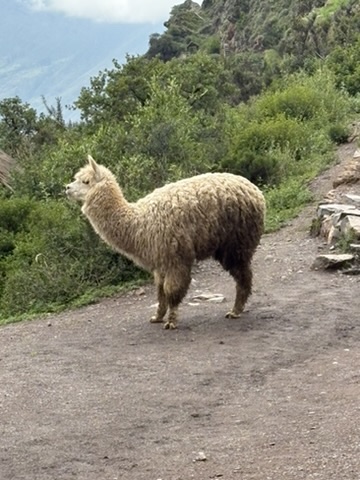
7- a beautiful alpaca in Pisac (not yet sheared)
8- high up in the mountains at 3500metres, the ruins of the village include pre-Inca (Wari) and Inca structure. It is again a hike up steep and higher than normal. We continue to look for our air but it is already better than yesterday. The view up there is spectacular! they believe that villages were built up high to avoid the massive flooding that would occur in the rain season in the valley.
The village up in the side of the mountain was abandoned in the time of colonization and a newer small village was built in the valley in the 15th century.
He also points out holes in the mountains which is a cemetery. Incas had buried their dead’s there in a fetal position – ready for the next life. Almost all have skull damage, indicating that there was a battle here to conquer the people. The holes are there because of grave robbers but there are many more dead’s buried there.
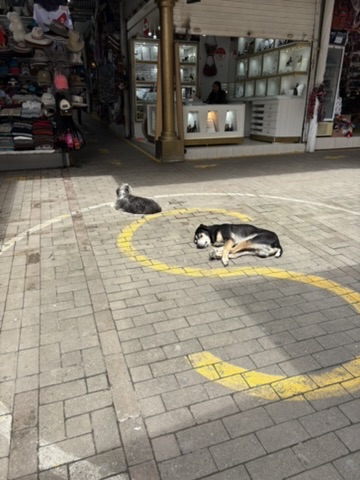
9- One observation as we leave the sacred valley. There are scores of dogs wandering around freely in all the rural area. More small dogs than big ones. They are obviously cared for and fed but loose. All are very calm, hang around together and I didn’t once see a reactive or aggressive dog. Very interesting.
 Martine's food and places