Trip to Sacred Valley, Peru – 1st chapter
January 5th 2024
Our trip to Sacred Valley in Peru – 1st chapter
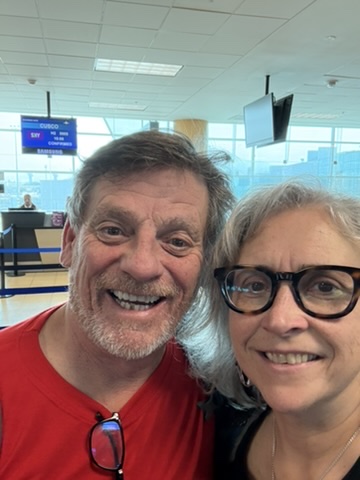
1- Chuck and I boarding in Lima
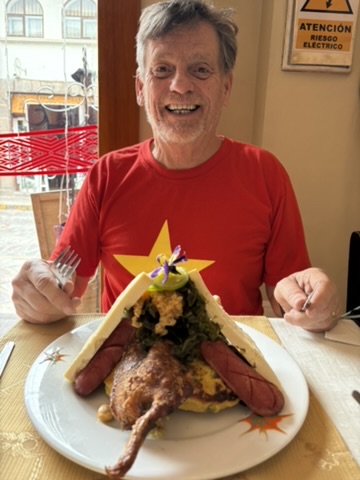
2- Chuck having his first typical local meal – basically all kinds of meat with a fat corn pancake and the best Andean cheese ever!
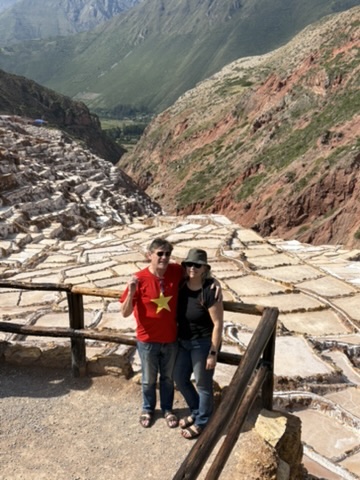
3 + 4 – the Maras salt mine – such an interesting place. These platform “mines” are very interesting in their ownership structure as well as the method to extract salt and the source of the salt water.
The salt water comes from pockets in the earth. Their origins is a source of many legends but we are far from the sea so it is very odd.
To extract the salt, they flood the platform twice a year for 3 months beginning in April. Each platform receives 30cm of water and the sun enables the evaporation. From time to time the family will move a salt layer that accumulates at the top to enable the rest to be evaporated. The end result is 3 layers of salt, the top white one is the best for domestic consumption (the flower of salt), the next layer is pink and is for domestic consumption as well. The next level is black-ish and is sold to companies and used for commercial purposes, one of which is ….. processed food  .
.
The platforms are all owned by local families going back hundreds of years. Each family may own 5 to 30 platforms. They formed a cooperative that manages the process and takes care of sales. The families can only sell their platform to another family that lives within the surrounding area. They are now expanding the platform to the end of the valley and now those who live in those areas will own the new platform. The government protects this ownership structure and no large company can ever own the platforms.
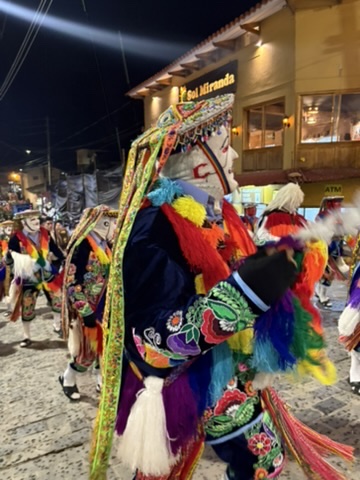
5- we arrive in Ollantaytambo for a catholic celebration with parades, music and dances. This is a very safe city mostly populated by Inca descendants. Very fun party that will last 4 days.
6 – In that city, there are Incas and pre-Incas ruins. There is an intact pre-inca temple dedicated to water where a canal bring water from the nearby Andes mountain with a window above facing the sun.
We discuss these ancient civilizations include the very first one more than 5000 before JC named Caral (north of Lima) and we still see their signs “Chacana” carved in one of the stone, adopted by the Inca. Jose explain that the Incas method to conquer was to assimilate the other civilizations by their princes or kings marrying the princess from the conquered. These tribes also all believe in a creator of the world as well as many gods related to nature like the sun, the air, the water. The Incas incorporated the names used to refer to the creator in how they named him in their religious ceremony. So the name they used became a combination of all those names. They also always offer to exchange their knowledge for the knowledge of the conquered so that they could build on that.
While they also had big battles as there was in Europe, the difference is that they were not trying to annihilate the culture of those defeated but rather incorporate/assumilate it to build on it.
Peru also handles their native people – descendants of the Incas – much differently than Canada. They live side by side with the Europeans descendants called Metzi, while also there are mostly Inca town (like Ollantaytambo) who live and dress as Incas. This is welcomed and allowed. There are no “reserve” and no separate political structure/rulers. They are all governed by the local government who will be composed of all the communities. Discrimination does not seem prevalent here. Seems like a better way.

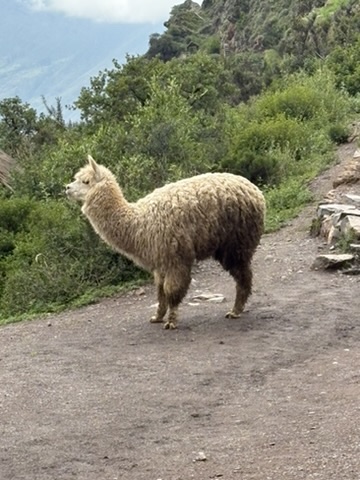
7- a beautiful alpaca in Pisac (not yet sheared)
8- high up in the mountains at 3500metres, the ruins of the village include pre-Inca (Wari) and Inca structure. It is again a hike up steep and higher than normal. We continue to look for our air but it is already better than yesterday. The view up there is spectacular! they believe that villages were built up high to avoid the massive flooding that would occur in the rain season in the valley.
The village up in the side of the mountain was abandoned in the time of colonization and a newer small village was built in the valley in the 15th century.
He also points out holes in the mountains which is a cemetery. Incas had buried their dead’s there in a fetal position – ready for the next life. Almost all have skull damage, indicating that there was a battle here to conquer the people. The holes are there because of grave robbers but there are many more dead’s buried there.
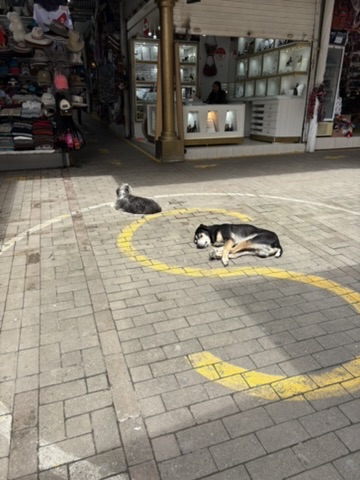
9- One observation as we leave the sacred valley. There are scores of dogs wandering around freely in all the rural area. More small dogs than big ones. They are obviously cared for and fed but loose. All are very calm, hang around together and I didn’t once see a reactive or aggressive dog. Very interesting.

Posted on February 1, 2025, in Sacred Valley + Galapagos island 2025, Travels and tagged cusco, machu-picchu, peru, sacred valley, south-america, travel, Travels. Bookmark the permalink. Leave a comment.
 Martine's food and places
Leave a comment
Comments 0